Most people handle bad breath the same way. A mint before the meeting, a swish of mouthwash, a stick of gum on the way out. It works for twenty minutes or so, and then the smell quietly comes back.
There’s a reason for that. Most breath products are built to cover an odour, not to deal with what’s producing it. Miswak works on the source instead: the bacteria, the leftover food they live on, and the dry, stagnant conditions that let them multiply. That’s why people who switch to it tend to say their breath stays fresh for longer, not just that it smells nice straight after use.
Below, we’ll cover where bad breath actually comes from, what a miswak does about it, how to use one specifically for fresher breath, and the situations where no stick in the world is going to help.
| ⚡ Quick answer: Does miswak help with bad breath?Yes, for the most common kind. Most bad breath starts in the mouth, where bacteria on the tongue and around the teeth break down food and dead cells and give off smelly sulphur gases. A fresh miswak scrubs away what those bacteria feed on, releases natural antibacterial compounds, and gets saliva flowing again. In a clinical trial on fasting volunteers, miswak sticks lowered the sulphur compounds behind bad breath. It will not fix breath problems caused by advanced gum disease, tonsil stones, sinus issues or medical conditions. |
If you want the wider evidence on plaque, gums and bacteria first, start with what the research says about miswak overall.
What Actually Causes Bad Breath?
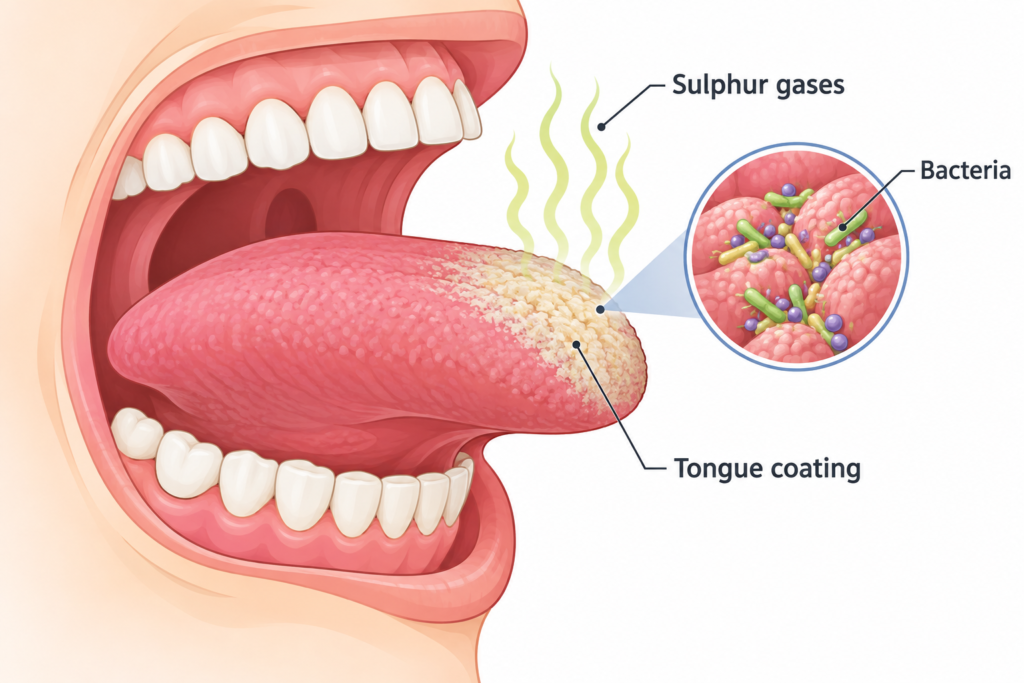
In most people, bad breath comes from volatile sulphur compounds, or VSCs. These are gases that bacteria release when they break down proteins from food scraps, dead cells and mucus. They belong to the same chemical family as the smell of rotten eggs, which explains a lot.
Where those bacteria live matters more than most people realise, according to Johns Hopkins Medicine, most of the bacteria behind bad breath sit on the tongue, and the ones toward the back react with amino acids from food to produce those sulphur compounds. You can brush your teeth perfectly and still have bad breath if the tongue never gets touched.
Most odour-producing species are also anaerobic. They do best in low-oxygen corners: the grooves of the tongue, the gaps between teeth, and the film of plaque that settles along the gumline. Anything that disturbs those corners and keeps the mouth moist makes life harder for them.
| Source of the smell | Why it smells | Can miswak help? |
|---|---|---|
| Coating on the back of the tongue | Bacteria break down proteins into sulphur gases | Yes, if you clean the tongue gently |
| Food trapped around teeth | Leftover food starts to rot | Partly. Floss for tight gaps |
| Plaque along the gumline | Bacterial film gives off odour | Yes, with regular use |
| Dry mouth and morning breath | Less saliva lets bacteria multiply | Yes. Chewing gets saliva going |
| Garlic, onions, coffee | Odour compounds are exhaled from the lungs | Only briefly |
| Smoking | Dries the mouth and shifts bacteria | Very little |
| Advanced gum disease | Deep pockets trap bacteria out of reach | No. See a dentist |
| Tonsils, sinuses, reflux, medical causes | The source is outside the mouth | No |
How Does Miswak Freshen Your Breath?
Miswak freshens breath in four ways: it removes the debris odour bacteria feed on, it acts on the bacteria themselves, it increases saliva flow, and it leaves the mouth clean rather than perfumed. Each one on its own is modest. Together they explain why the effect lasts.
1. It clears away what the bacteria eat
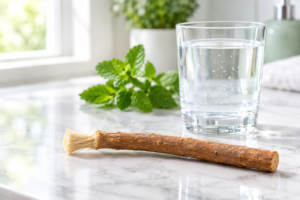
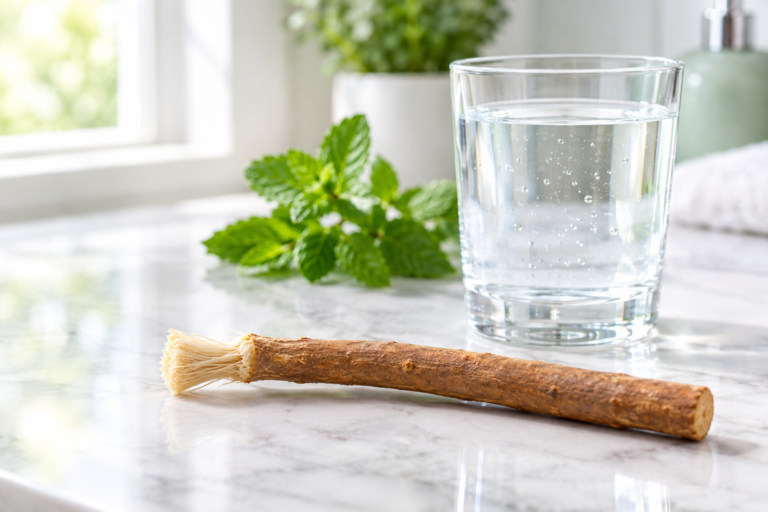
When you chew the tip of a fresh stick, it splits into soft fibres that work like a small, flexible brush. They reach along the gumline and into the curves behind the front teeth, lifting off food residue and soft plaque. Less raw material means less sulphur gas. It’s simple, but this mechanical part probably does more of the work than any single compound.
2. It goes after the bacteria that make the smell
The main antibacterial compound in Salvadora persica root is benzyl isothiocyanate, or BITC. In a laboratory study published in PLoS One, researchers found it acted quickly against gram-negative bacteria and visibly damaged their cell walls.
Here’s why that’s relevant to breath. The bacteria best known for producing sulphur gases, including Porphyromonas, Prevotella and Fusobacterium, are mostly gram-negative anaerobes. So the chemistry lines up nicely with the job. To be fair, that lab work wasn’t measuring breath directly, so treat the overlap as encouraging rather than proof. If you want the detail on which species miswak targets and which it leaves alone, we’ve laid it out in our breakdown of miswak and oral bacteria.
3. It gets saliva moving
Saliva is your mouth’s built-in rinse. When it dries up, odour follows fast. The American Dental Association points to medications, salivary gland problems and simple mouth breathing as common causes of dry mouth. Chewing on a miswak tip prompts saliva flow, which washes away loose debris and keeps the mouth from turning into the still, dry environment odour bacteria like best.
4. It cleans instead of masking
Miswak doesn’t taste of mint. A fresh stick has a sharp, slightly peppery bite, a bit like mustard or cress, and it fades to a clean, neutral feeling. That sounds like a drawback until you think about it. Because nothing is covering the odour, you get an honest signal: if your breath still smells after proper cleaning, something else is going on.
What Does the Research Say About Miswak and Bad Breath?
The direct evidence on breath is smaller than the evidence on plaque and gum health, but what exists points the same way.
The most useful study is a crossover clinical trial with 35 healthy volunteers, all of them fasting. Each person tried two methods at different times: a Listerine Cool Mint rinse, and Salvadora persica sticks used on plaque at and just below the gumline. Researchers checked sulphur compound levels, bacterial counts, odour ratings and tongue coating at 1, 5 and 9 hours afterwards. The miswak sticks lowered sulphur compounds and anaerobic bacteria, and they left more of the aerobic, mostly harmless bacteria in place than the rinse did.
The fasting detail matters. With no food coming in, there’s nothing to muddy the results, and it reflects real conditions for anyone fasting through a long day.
Beyond that, a Cochrane review of bad breath treatments lists a trial comparing miswak sticks with chlorhexidine rinse in students with halitosis. That trial was unpublished, so it carries limited weight, and the bad breath research field as a whole is fairly thin.
So the honest summary is this: the mechanism makes sense, the small trials are positive, and large long-term studies focused on breath haven’t been done yet.
How to Use Miswak for Fresher Breath
Use a fresh, moist stick, trim the tip, brush your teeth with short gentle strokes, then clean your tongue lightly from back to front. Do it when you wake up and after meals.
- Start with a fresh stick. A miswak that has dried out loses much of its active compounds and becomes little more than wood. If you’re unsure, here are the signs a stick is past its best. Brand new? Follow our steps for soaking and peeling a new miswak first.
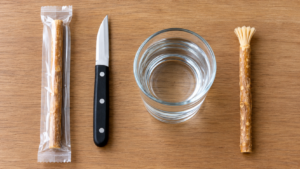
- Trim and chew the tip. Cut back to clean wood and chew about a centimetre until the fibres are soft and separated.
- Brush your teeth gently. Short vertical strokes, light pressure, and pay attention to the gumline and the back molars where food collects. Our guide to miswak brushing technique shows the angles.
- Clean your tongue. Use the soft fibres to sweep from the back of the tongue toward the tip, three or four passes. Go only as far back as feels comfortable. A tongue scraper works well alongside it.
- Rinse with water if you have it, and spit out any loose fibres.
- Store it properly. Keep the stick clean and airy between uses. A damp, sealed box can make it smell, which defeats the point. Here is how to store miswak so it stays usable.
| When to use it | Why it helps your breath |
|---|---|
| Right after waking | Saliva drops overnight, which is what causes morning breath |
| After meals | Removes food before bacteria start breaking it down |
| Before prayer, meetings or social plans | A quick refresh with no sink or water needed |
| During long gaps without food or drink | Chewing restarts saliva flow |
Not sure how many sessions a day is sensible? Our piece on daily miswak frequency covers it.
Miswak vs Mints, Gum and Mouthwash for Bad Breath
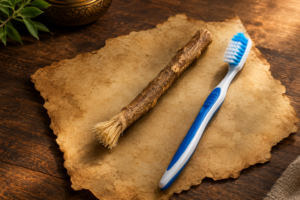
Mints and many mouthwashes mainly cover the smell. Miswak removes some of its cause. The best results come from combining good habits rather than relying on one product.
The Cleveland Clinic makes the same distinction: some mouthwashes only mask odours, while others actually act on bacteria. It also recommends sugar-free gum to boost saliva, which is sound advice.
| Option | What it does | Main limitation |
|---|---|---|
| Mints | Covers odour with flavour | Short-lived. Sugary ones feed bacteria |
| Sugar-free gum | Boosts saliva | Doesn’t touch the tongue or plaque |
| Mouthwash | Masks odour, or reduces bacteria if antibacterial | Doesn’t remove plaque. Alcohol-based rinses can feel drying for some people |
| Miswak | Removes debris, acts on bacteria, boosts saliva | Needs a fresh stick and good technique. Doesn’t clean between teeth |
For a fuller side-by-side, see how miswak compares with rinses. Either way, keep brushing with fluoride toothpaste and flossing daily. Miswak fits in well alongside that, and we’ve explained how to pair it with your regular toothpaste.
Miswak for Bad Breath While Fasting
Fasting breath is real. After hours without food or water, saliva drops and the tongue coating builds up. Miswak is practical here because it needs no water and nothing to swallow.

That is partly why so many Muslims keep a stick close through Ramadan, and why the fasting trial above is so relevant. The practice itself goes back to the Prophet ﷺ, which we cover in the Sunnah behind the miswak.
Two practical points. First, spit out loose fibres and anything that breaks off rather than swallowing it. Second, scholars differ on using miswak in the afternoon while fasting, and on moist versus dry sticks, so follow the view of your own school or ask a scholar you trust.
When Miswak Won’t Fix Bad Breath
If your breath still smells after a couple of weeks of thorough cleaning, including your tongue, the source probably is not surface bacteria. That is the time to see a dentist or doctor.
Watch for these signs:
- Bleeding, swollen or receding gums, or a bad taste that never leaves. The ADA flags these as possible signs of advanced gum disease, which needs professional treatment. If your gums are already tender, read our advice on using miswak with sensitive gums before you start.
- Small white or yellow lumps at the back of the throat. These may be tonsil stones.
- A blocked nose, post-nasal drip or sinus pain. The odour may be coming from the nose and throat.
- Heartburn or a sour taste after eating. Acid reflux can affect breath.
- Dry mouth that started with a new medication. Don’t stop the medicine yourself. Talk to whoever prescribed it.
- An unusual smell, such as fruity or ammonia-like. Conditions like diabetes, kidney disease and liver disease can change breath odour. See a doctor.
Choosing a Miswak That Actually Freshens Breath
Not every stick sold as miswak will do the job. For breath, freshness is the whole game.
- Genuine Arak (Salvadora persica). Most of the research was done on this species. Here’s how Arak compares with Peelu, Neem and other sticks.
- Moist and flexible. The wood should bend a little, not snap.
- A sharp, peppery taste when chewed. If it tastes like plain wood, the active compounds have largely gone.
- Sealed packaging. This holds in moisture from harvest to the customer.
| For retailers, pharmacies and distributors: Al Safaa Miswak supplies fresh, vacuum-sealed Arak miswak sticks in bulk, harvested from genuine Salvadora persica and packed to export hygiene standards. Browse our Arak miswak range, look at our private-label packaging options, or request wholesale pricing. |
Frequently Asked Questions
How quickly does miswak improve bad breath?
Most people notice a cleaner, fresher mouth in the same session. For a lasting change, give it a couple of weeks of regular use, and make sure you clean your tongue as well as your teeth.
Can miswak cure chronic bad breath?
Not on its own. It helps with the common kind that comes from bacteria in the mouth. Long-term bad breath caused by gum disease, tonsil stones, sinus problems or a medical condition needs a dentist or doctor.
Should I use miswak to clean my tongue?
Yes, gently. Sweep the soft fibres from the back of the tongue toward the tip a few times. Most odour bacteria live on the tongue, so skipping it leaves the main source untouched.
Is miswak better than mouthwash for bad breath?
They do different jobs. Many mouthwashes mainly cover odour, while miswak removes debris and acts on bacteria. Plenty of people use miswak during the day and keep brushing with fluoride toothpaste at night.
Why does my miswak smell bad?
It has usually been stored damp in a closed container or used for too long without trimming. Cut back to fresh wood, let it air, and replace it if the smell stays.
Can I use miswak for bad breath while fasting?
Yes, many people do. It needs no water. Spit out any loose fibres, and follow your own school of thought on using it later in the day.
Does miswak help with morning breath?
Yes. Morning breath comes from low saliva overnight. Using a miswak soon after waking, including a light tongue clean, gets saliva flowing and clears the build-up.
Do I still need toothpaste if I use miswak?
Yes. Miswak does not replace the cavity protection from fluoride toothpaste. Use both, and floss daily to clean between the teeth.
The Bottom Line
Miswak freshens breath by dealing with the cause rather than hiding it. It clears away food and plaque, works against the bacteria that make sulphur gases, and keeps saliva flowing. The small amount of direct research supports it, and the mechanism makes sense.
It works best as part of a routine: a fresh stick, a gentle tongue clean, fluoride toothpaste and floss. And if your breath still isn’t right after a few weeks of that, it’s worth getting checked, because the answer may not be in your mouth at all.