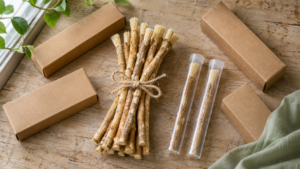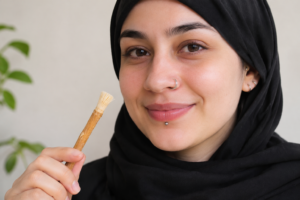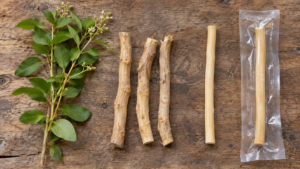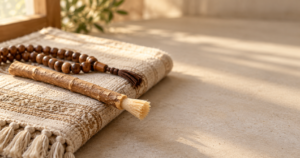
Short answer: No. Using a miswak does not break your fast. All four Sunni schools allow a fasting person to use one, and the Prophet ﷺ was seen using it while fasting. Your taste is only affected if something goes down your throat — a broken wood fiber or the flavoring added to a scented stick.
That is the whole ruling in four lines. The rest of this page is for the questions that come after it: wet stick or dry, before noon or after, what to do if a bristle slips down, and whether the mint ones are a problem.
Why the question comes up every Ramadan
By eleven in the morning, your mouth has gone dry and stale. Saliva drops off sharply during a fast, and the bacteria that cause odor take advantage of it. So you reach for something — and then stop, because the stick is damp, it has a taste, and little fibers come loose when you brush.
That hesitation is reasonable. It is also the reason a practice that is kept as a daily Sunnah the rest of the year suddenly feels risky for thirty days.
The ruling, plainly
Jurists across the four madhhabs treat the miswak as permissible for a fasting person. The encyclopaedia of fiqh at Dorar records it as agreed upon: a fasting person may use the siwak, and the natural taste of the wood does not invalidate anything.
The evidence sits in the practice itself. The Companion Rabi’ah ibn Amir reported seeing the Prophet ﷺ use the miswak while fasting more times than he could count. Nobody treated it as a loophole or a concession; it was simply normal.
The one point the schools differ on
Three of the four schools — Hanafi, Maliki and Hanbali — see no dislike in it at any hour, before or after midday.
The Shafi’i school is the exception. It holds the miswak to be makruh, or disliked, after the sun passes its zenith. The reasoning is not hygiene but reward: the hadith that the breath of a fasting person is more pleasant to Allah than musk. Jordan’s Dar al-Ifta states this position directly — permissible before noon, disliked afterwards, to preserve that trace of the fast in the mouth.
Note what this is not. Even in the Shafi’i view, nobody says the fast breaks. Disliked and invalid are two different categories. If you follow that school and you have a dental appointment, a meeting, or an odor that is bothering people around you, ask your own teacher rather than guessing from a web page — the fuqaha treat genuine need differently from habit.
Wet miswak or dry one?
This is the question people ask most, and the safest practice is the one everybody agrees on anyway.
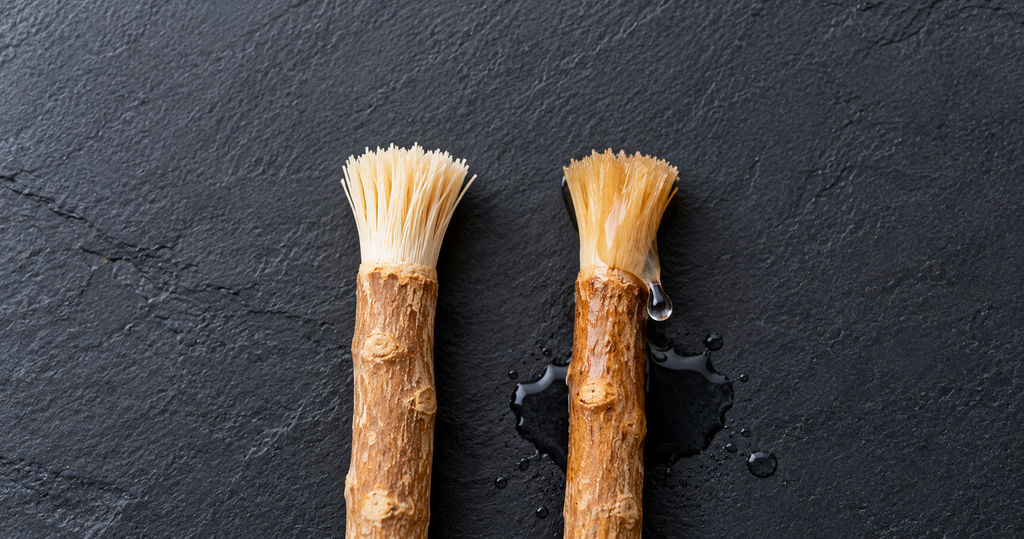
Keep it dry during fasting hours. If you have soaked the tip to soften it, shake the water off until nothing drips, and spit once when you finish. The Jordanian fatwa puts the test in a way you can actually apply: if the stick is slightly moist but releases no liquid when you squeeze it, using it does not break the fast.
Hanafi scholars are more relaxed still — wetting the stick before use is permitted, with the same advice to spit once afterwards. Either way, the rule that matters is simple: nothing swallowed, nothing dripping.
A practical note from people who use one daily. Soak the stick at night after iftar, not in the morning. By Fajr the fibers have softened and dried on the surface, which gives you a soft brush with no moisture to worry about all day.
What if you swallow a fiber?
Here the answer changes, so it is worth being precise.
If you are certain a piece of wood went down your throat, the fast is invalidated, and that day needs to be made up. If you only suspect it — you felt something, and you are not sure — the fast stands. The principle the Hanafi scholars apply is that certainty is not removed by doubt, and your certainty was that you were fasting.
Most of this is avoidable with the stick itself. Loose bristles come from an over-chewed tip or a stick that has dried out past its useful life. Trim the frayed end back every day or two, and when you start a new stick, prepare the tip properly instead of chewing a long section soft in one go. Brush, then spit — do not swallow the first mouthful of saliva out of habit.
Does the taste left in your mouth count?
No. The taste of the wood remaining in your mouth does not invalidate the fast.
Tasting food without need is disliked across the schools, but that ruling is about food you put in your mouth and take out again. The slight peppery warmth of arak comes from the stick you are brushing with, not from something you are eating. You do not need to rinse it away.
Mint, lemon, and other flavored sticks
Flavored miswak is a different matter and worth understanding before Ramadan rather than during it.
The flavor in a mint or lemon stick is added. It is not what arak tastes like. Because of that, scholars at Askimam have ruled that using a flavored miswak while fasting should be avoided: you are tasting something with no need for it, and the flavoring can carry past the throat.
The simple way to round it is to keep two sticks. A plain arak stick cut from the usual wood for the fasting hours, and the flavored one after iftar if you like it. Shops that sell both tend to see exactly this split in Ramadan.
A fasting day, hour by hour
| When | What to do |
|---|---|
| Suhoor | Brush properly with toothpaste before Fajr comes in. This is the real clean of the day. |
| Fajr | Dry miswak before the prayer, a few strokes per section, then spit once. |
| Mid-morning | Short pass when the mouth feels dry. Nothing soaked, nothing swallowed. |
| Dhuhr | Before the prayer, as usual. |
| Asr onwards | Hanafi, Maliki, and Hanbali: carry on. Shafi’i: this is the window you would normally leave. |
| Iftar | Rinse after dates and water, then use the stick once you have eaten. |
| Taraweeh | A quick freshen before standing for a long prayer. |
| Before sleep | Sunnah, and it keeps the overnight bacteria count down before suhoor. |

Four or five short sessions is plenty. Grinding away at your gums all day because your mouth feels dry will do more harm than the dryness — the motion itself matters more than the number of passes.
What the stick is actually doing for fasting breath
Fasting breath has a cause. Saliva flow drops when you stop eating and drinking; saliva is what washes bacteria off the tongue and gums, and the sulfur compounds those bacteria produce are what you can smell by afternoon.
A miswak works on that in two ways at once. The frayed fibres lift plaque mechanically, the same job a brush head does, and the wood releases natural antibacterial compounds while you use it. Clinical reviews comparing miswak with toothbrushing have found plaque and gingivitis scores at broadly similar levels over short study periods, which is a reasonable claim to make and a more honest one than saying it beats a toothbrush.
What it does not do is replace a proper brush-and-paste at suhoor and after iftar. Treat the miswak as the thing that carries you through the day, not the whole routine.
When to ask instead of guessing
Ask your own scholar if you follow the Shafi’i school and need to use it after noon, if you are making up missed fasts and have swallowed something you are unsure about, or if a dentist has told you to avoid abrasion on a specific tooth. Rulings get specific when circumstances do, and a general page cannot do that work for you.
Frequently Asked Questions
Does a wet miswak break the fast?
No. The safer practice is to use it dry, but a slightly moist stick that releases no liquid when squeezed does not break the fast. Shake off any water before you start and spit once when you finish rather than swallowing.
Can I use a miswak after Asr?
Hanafi, Maliki, and Hanbali scholars say yes, at any hour. The Shafi’i school considers it disliked after midday so that the fast’s effect on the mouth is left alone. Either way, the fast remains valid.
What happens if I swallow a piece of the stick?
If you are certain a fiber went down, the fast is broken, and the day must be made up; if you are only unsure, your fast stands. Trimming the frayed tip regularly prevents it almost entirely.
Is a mint- or lemon-flavored miswak allowed while fasting?
Scholars advise against it. That flavor is added rather than natural, so using it means tasting something without need, with a risk of it passing the throat. Keep plain arak for daytime and the flavored stick for after iftar.
Can I use toothpaste instead during the day?
It is permitted but widely discouraged because swallowing paste or saliva changes invalidates the fast. Most people keep toothpaste for suhoor and after iftar and use the miswak in between.
How many times a day can I use it while fasting?
As often as you like, though four or five short sessions cover it — before each prayer and at suhoor. Short passes with light pressure beat long scrubbing, especially on gums that are already dry.