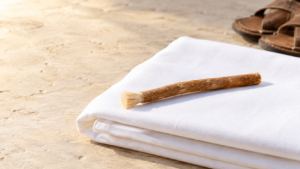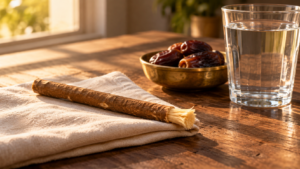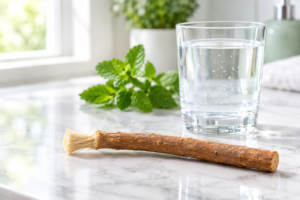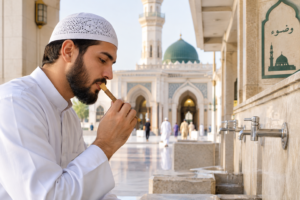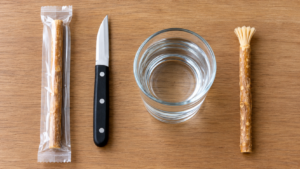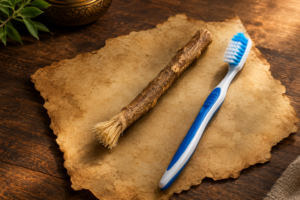
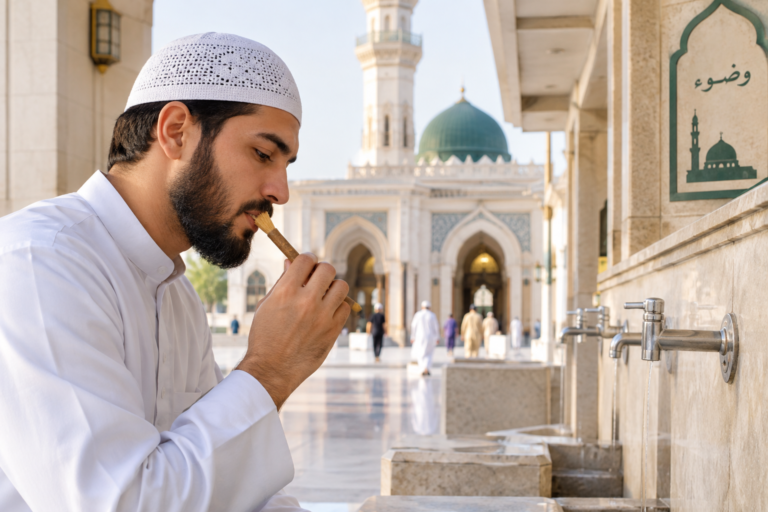
Stand near the wudu area of almost any masjid before Jumu’ah, and you will see it happen. A man finishes washing, pulls a short brown stick out of his top pocket, runs it across his teeth for half a minute, and slips it back. Nobody around him gives it a second look. To them, it is as ordinary as rolling up a sleeve.
People outside the faith often assume this is about dental hygiene or about holding on to tradition for its own sake. Both play a part, but neither is the real reason. Muslims reach for the miswak because the Prophet Muhammad ﷺ reached for it, often and said things about it that his followers have repeated for fourteen centuries. This guide walks through those narrations, the moments of the day they tie the stick to, and the practical questions people ask once they start taking the habit seriously.
The Short Answer
Muslims use miswak because it is a Sunnah: a practice of the Prophet Muhammad ﷺ, who used it before prayer, on waking, and on entering his home, and who described it as purifying for the mouth and pleasing to Allah. It is strongly recommended but not compulsory, and its health benefits are seen as a bonus to an act of worship rather than the main motive.
New to the stick itself? Our beginner’s overview of the miswak explains what it is and how it differs from a brush.
It Starts With One Sentence
One narration shapes almost everything that follows. Abu Hurayrah reports that the Prophet ﷺ said that if he had not feared making things hard for his community, he would have ordered them to use the siwak with every prayer. It is recorded in Sahih al-Bukhari 887 and in Sahih Muslim 252.
Read that slowly, because the logic is unusual. He is telling people he wanted to make it a duty and chose not to. Scholars drew two conclusions. The first is that the miswak is not obligatory, so a prayer offered without it is complete and valid. The second is that it sits very close to the line, which is why jurists placed it among the most emphasised voluntary practices, the Sunnah mu’akkadah.
Anas ibn Malik adds a blunter line. The Prophet ﷺ told his companions that he had spoken to them about the siwak a great deal (Bukhari 888). Nobody keeps repeating advice they consider minor.
What the Key Hadith Actually Say
Most of the religious reasoning rests on a small group of authentic reports. These are the ones you hear quoted in Friday sermons and madrasa classes.
| Narration | What it establishes | Source |
|---|---|---|
| Siwak purifies the mouth and pleases the Lord | A double purpose: physical cleanliness and Allah’s pleasure | Sunan an-Nasa’i 5 (sahih) |
| He would have ordered it for every prayer, were it not a hardship. | Strongly recommended; deliberately left voluntary | Bukhari 887, Muslim 252 |
| The first thing he did on entering his house was use the siwak | Using it at home, before sitting with family | Muslim 253 |
| On rising at night he cleaned his mouth with the siwak | Using it on waking and before night prayer | Bukhari 889, Muslim 255 |
| Siwak is one of the ten acts of fitrah | It belongs to natural, everyday grooming | Muslim 261 |
| The siwak on his tongue while he made a retching sound | He cleaned the tongue too and did it thoroughly | Bukhari 244, Muslim 254 |
The first narration on that list answers the question in this post’s title better than anything else. In Arabic, it is short enough to memorize:
السِّوَاكُ مَطْهَرَةٌ لِلْفَمِ مَرْضَاةٌ لِلرَّبِّ
Transliterated, it reads as as-siwaku matharatun lil-fam, mardatun lir-Rabb.” Notice how it joins the body and the soul in one breath. Cleaning your mouth is not framed as a chore that sits beside worship. It is framed as worship. You can read the full chain on Sunan an-Nasa’i 5.
Part of Fitrah, Not Just Ritual
In Sahih Muslim, Aisha narrates a list of ten practices the Prophet ﷺ called fitrah, meaning the natural disposition human beings are created with. The siwak appears there next to trimming the moustache, clipping the nails, and rinsing the mouth and nose (Muslim 261).
That grouping matters. It puts the miswak alongside basic grooming, the kind of thing a decent person does anyway, rather than among special devotions kept for particular days. It also explains why most Muslims feel no tension between their faith and their dentist. Keeping clean is part of the religion. Which tool cleans best is a question the religion is comfortable leaving to experience.
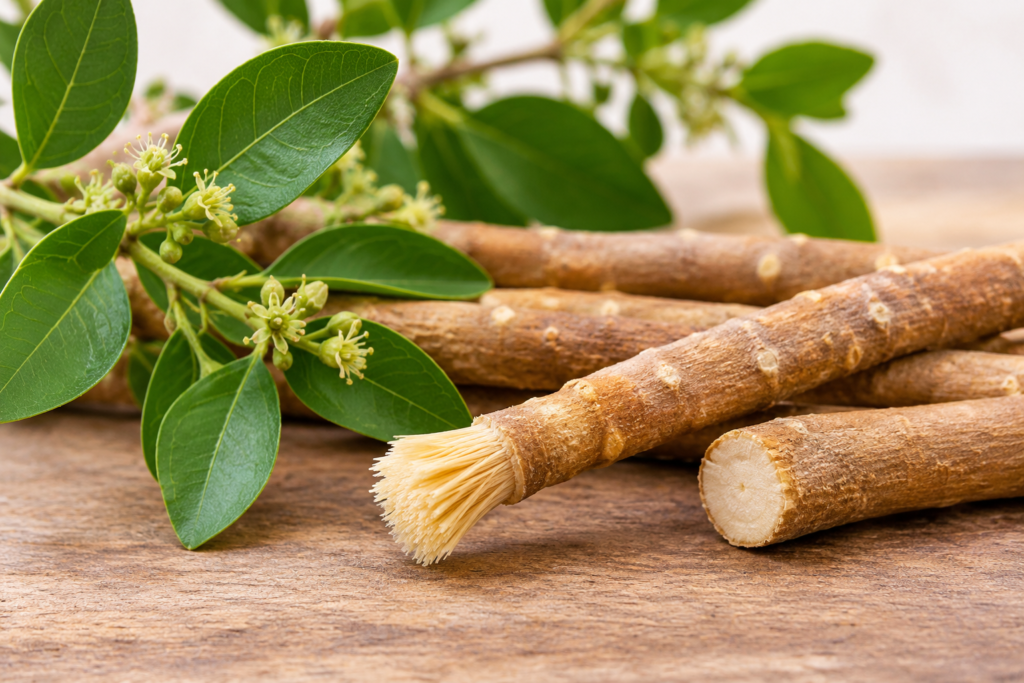
The wood behind the classic stick comes from the arak or Salvadora persica tree, and the long road the chewing stick travelled before and after the seventh century is traced in our timeline of miswak through the ages.
When Muslims Use Miswak During the Day
Classical fiqh books name specific moments when the miswak is especially recommended. They draw on the narrations above and on a wider principle: the mouth should be clean whenever a person turns to Allah.
| Moment | Why it is recommended |
|---|---|
| Before each salah | The direct wording of Bukhari 887 and Muslim 252 |
| During wudu | A variant wording of the same hadith mentions every ablution; many scholars place it just before rinsing the mouth |
| On waking, especially for tahajjud | Hudhayfah’s report of the Prophet ﷺ cleaning his mouth when he rose at night |
| On entering the home | Aisha’s report in Muslim 253 |
| Before reciting the Qur’an | Recommended by scholars so the mouth is clean for the words of Allah |
| Before Jumu’ah | Bukhari 880 mentions siwak together with the Friday bath and perfume |
| Whenever the breath has changed | After sleep, long silence, or hunger, based on the general purpose of the practice |
Put together, that can mean five, six or more short sessions a day. It sounds like a lot until you notice each one takes under a minute. For the dental side of that routine, including how often is realistic alongside a brush, see how many times a day works in practice.
Sunnah, Not Fard, and One Narration to Handle Carefully
This gets blurred a lot online, so it is worth stating plainly. The miswak is recommended. Leaving it is not a sin, and it has no bearing on whether your wudu or your prayer is valid.
You will also come across a popular claim that a prayer offered after using the siwak is worth seventy prayers without it. Versions of that report appear in collections such as Musnad Ahmad and al-Bayhaqi, but hadith specialists have graded their chains weak. If you share it, share it with that caveat attached. Honestly, the authentic narrations above make the case perfectly well without it.
Why a Stick? Does a Toothbrush Count?
Classical jurists did not tie the Sunnah to one type of wood. The broad position across the schools is that anything clean, rough enough to remove residue, and not harmful achieves the purpose, and many contemporary scholars include the toothbrush in that. Where they agree just as widely is on what is best: the arak twig, because that is what the Prophet ﷺ used. A well-known report in Musnad Ahmad describes Abdullah ibn Mas’ud climbing an arak tree to cut siwak sticks, and the companions laughing at how thin his legs looked.
So a Muslim who uses a toothbrush has not abandoned cleanliness, but someone who wants the Sunnah in its fullest form picks up an arak stick. Plenty of families do both, keeping the miswak for the day and a fluoride paste at night. If you are wondering how those two fit together, we answered whether miswak and toothpaste can be combined in a separate post.
Other woods, such as neem and olive, are used as chewing sticks in different regions. The differences in texture, taste and research backing are set out in our comparison of arak, peelu, neem and date palm sticks.
Faith Came First, the Science Came Later
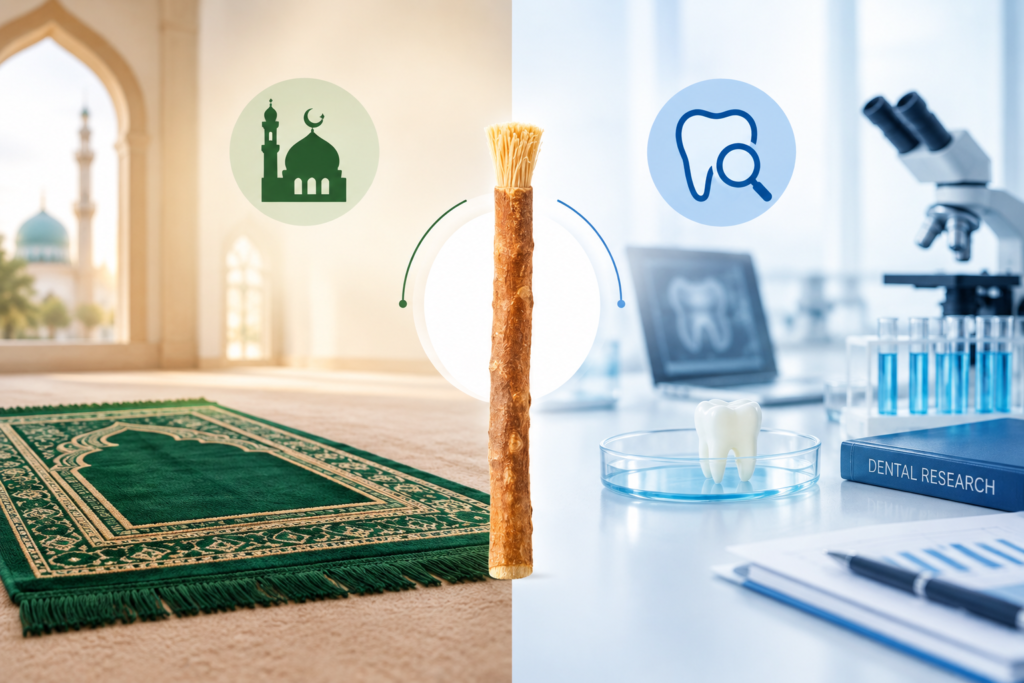
Muslims did not take up the miswak because a laboratory recommended it. They took it up more than a thousand years before anyone could test it. What is striking is that modern research has largely backed the habit. Clinical comparisons have found arak sticks reduce plaque and gum inflammation at levels broadly similar to a standard toothbrush, and the wood carries compounds with measurable antibacterial activity.
Believers tend to treat those findings as confirmation, not justification. The practice would still be a Sunnah if the studies had come back empty. For details, the evidence from clinical trials is summarized in one post, and the chemistry is explained in how arak wood targets harmful mouth bacteria.
The Etiquette Most People Learn at Home
The adab of the miswak is usually passed down by parents and imams rather than read from a book. These are the points you will hear most often:
- Which hand. Most people use the right hand, following the general Sunnah of using the right for honourable acts. A minority of scholars prefer the left because the act removes dirt. Both have a basis.
- Direction. Scholars mention brushing across the width of the teeth and along the length of the tongue.
- Keep it clean. Rinse the stick before and after use, and never use it inside the toilet area.
- Refresh the tip. Trim worn bristles and chew out a fresh end rather than scrubbing with a flattened one.
- Your own stick. Aisha once softened a siwak for the Prophet ﷺ, so sharing is not forbidden, but today most families simply give everyone their own.
For the practical side, there is a guide to the right brushing technique, another on cutting and softening a brand-new stick, and a checklist for keeping your miswak hygienic between uses. If your gums are tender or bleed, read the precautions for sensitive users first.
Children usually learn by copying an older sibling or a parent at the masjid. If you want to teach yours, we cover a safe way to start kids on miswak.
In Ramadan, on Hajj and on Umrah
While fasting. The majority of scholars allow the miswak throughout the fasting day. The Shafi’i school, and one view among the Hanbalis, traditionally regarded it as disliked after midday, based on the hadith about the scent of a fasting person’s mouth being beloved to Allah. Whichever view you follow, be careful not to swallow loose fibres or juice from the stick.
On pilgrimage. Miswak sellers line the streets around the Haram in Makkah and Madinah, and many pilgrims carry a stick throughout. Some prefer it while in ihram because it avoids any question over scented toothpaste. Heat and packed bags dry sticks out quickly, so it helps to know how to keep miswak fresh while travelling.
The Last Thing He Asked For
Aisha narrates that during the Prophet’s final illness, her brother Abdur-Rahman came in holding a fresh siwak. She noticed the Prophet ﷺ looking at it. She took it, softened the end for him, and he used it. It was among the last things he did in this world (Bukhari 890).
Muslim children hear that story young, and it tends to stay with them. A habit someone kept to his final hours does not feel optional to the people who love him, even if the fiqh books technically call it so. That, more than any study, is why the stick is still sitting in so many top pockets.
Frequently Asked Questions
Is using miswak compulsory in Islam?
No. It is a strongly recommended Sunnah. The Prophet ﷺ said he would have made it obligatory before every prayer if it would not have been a hardship, which is exactly why it was left voluntary. Prayer and wudu are valid without it.
What is the most quoted hadith about miswak?
Two stand out. The first says the siwak purifies the mouth and pleases the Lord, recorded in Sunan an-Nasa’i. The second is the hadith about using it with every prayer, recorded in both Sahih al-Bukhari and Sahih Muslim.
Is miswak mentioned in the Qur’an?
The Qur’an does not name the miswak. It praises purity in general, for example, in Surah al-Baqarah 2:222, which says Allah loves those who keep themselves pure. The specific practice comes from the hadith.
Can women use miswak?
Yes. The Sunnah applies to men and women equally, and Aisha herself is one of the main narrators of the practice.
Does brushing with a toothbrush fulfill the Sunnah?
Many scholars say a toothbrush achieves the general purpose of cleaning the mouth. The fullest form of the Sunnah is still the arak stick, because that is what the Prophet used.
Can I use miswak while fasting in Ramadan?
Most scholars permit it at any time of the fasting day. The Shafi’i school traditionally considered it disliked after midday. In all cases, avoid swallowing any fibres or juice.
Why is arak wood preferred over other trees?
Because it is the wood the Prophet ﷺ and his companions used. Its soft, fibrous structure also makes it well suited to cleaning teeth without hurting the gums.
Do Muslims use miswak only before prayer?
No. Prayer is the best-known occasion, but it is also recommended on waking, when entering the home, before reading the Qur’an, before Friday prayer, and whenever the breath has changed.
The Bottom Line
Muslims use the miswak for the same reason they do most things the way they do: someone they love and follow did it first. The Prophet ﷺ used it before prayer, at home, in the night, and at the very end of his life, and he tied it to both a clean mouth and the pleasure of Allah. The health benefits are real and welcome, but they arrived as a footnote to a practice that was already fourteen centuries old.
Stocking Miswak for Your Store or Masjid?
Ramadan and Hajj seasons bring predictable demand spikes, and Islamic bookstores, masjid shops, and pharmacies need stock that arrives fresh. Al Safaa Miswak supplies genuine Salvadora persica sticks in bulk to retailers and distributors worldwide. Learn who we are and how we source, browse the full wholesale miswak range, see our bulk miswak tooth stick supply, explore private-label packaging options, or request a wholesale quote today.