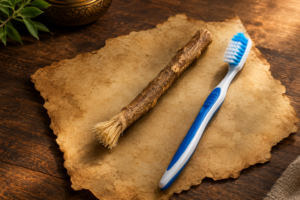
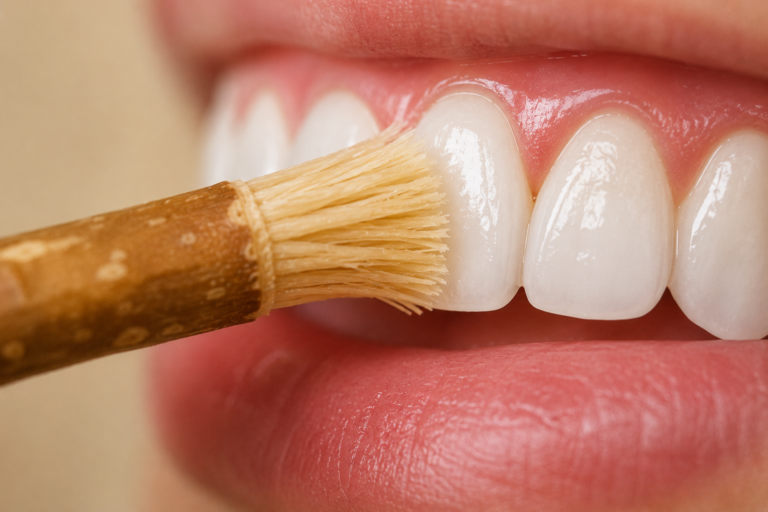
Plaque is the reason most dental appointments go badly. Not sugar on its own, not weak enamel, not bad luck. A soft film of bacteria that rebuilds itself on your teeth every few hours and that hardens into something a scaler has to chip off if you leave it long enough.
Miswak has a genuinely good track record against it, and the reason is more interesting than “it scrubs.” The twig works on plaque in three separate ways at once, and one of those has nothing to do with brushing at all. Here is what is actually happening.
The Short Answer
Miswak prevents plaque by physically breaking up the bacterial film, releasing antibacterial compounds that slow it from growing back, and stimulating saliva flow that neutralises the acid the bacteria produce. A toothbrush only does the first of those. Everything else has to come from the toothpaste you put on it.
That is the whole argument in one paragraph. The rest of this page explains why each mechanism matters and, just as importantly, where miswak falls short.
What Dental Plaque Actually Is
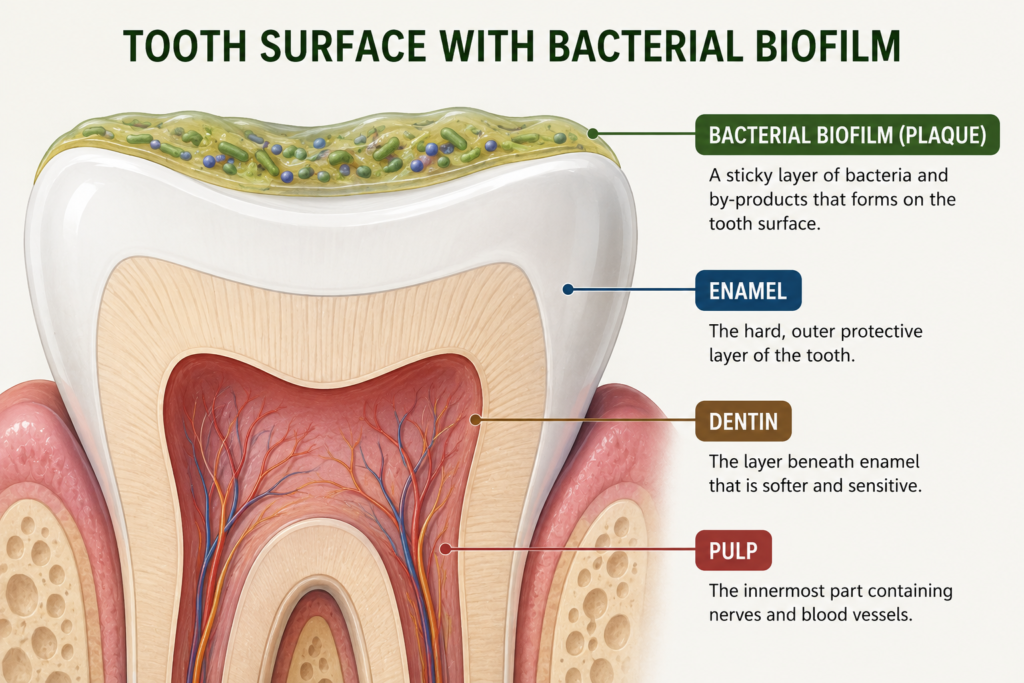
Most people picture plaque as trapped food. It is not. Plaque is a biofilm, meaning a structured colony of living bacteria that builds itself a protective sticky matrix and anchors it to your tooth surface. Food feeds it, but food is not what it is made of.
That distinction matters because it changes what you are trying to remove. Rinsing washes food away. It does very little to a biofilm, which is precisely why mouthwash alone never solved anyone’s plaque problem. Biofilms have to be physically broken apart. We put the two side by side in miswak vs mouthwash.
Left alone, the colony shifts in character. The early residents are relatively harmless. Given a day or two undisturbed, more aggressive oxygen-avoiding species move in, and those are the ones linked to gum disease and decay.
The Four Stages of Plaque Formation
The timeline is what makes the plaque manageable. Interrupt it early enough and it never becomes a problem.
| Stage | Timeframe | What happens | Still removable at home? |
|---|---|---|---|
| Pellicle forms | Minutes after cleaning | A thin layer of salivary proteins coats the enamel. Harmless on its own, but it is the surface bacteria latch onto | Yes, easily. |
| Early colonization | 4 to 12 hours | The first bacteria attach to the pellicle. The film is soft and loosely bound | Yes, easily. |
| Maturation | 12 to 48 hours | The colony thickens, harsher anaerobic species arrive, acid production climbs, and gums begin reacting. | Yes, but it takes proper effort. |
| Mineralization | From roughly day 10 | Calcium and phosphate from saliva harden the film into calculus, also called tartar. | No. Only a dental scaler removes it |
Look at where the cut-off sits. Everything before roughly 48 hours is yours to handle. After day ten, it is your dentist’s job. Plaque control is therefore mostly a question of never letting the film reach stage three, which is a frequency problem more than a technique problem.
How Miswak Interrupts the Process
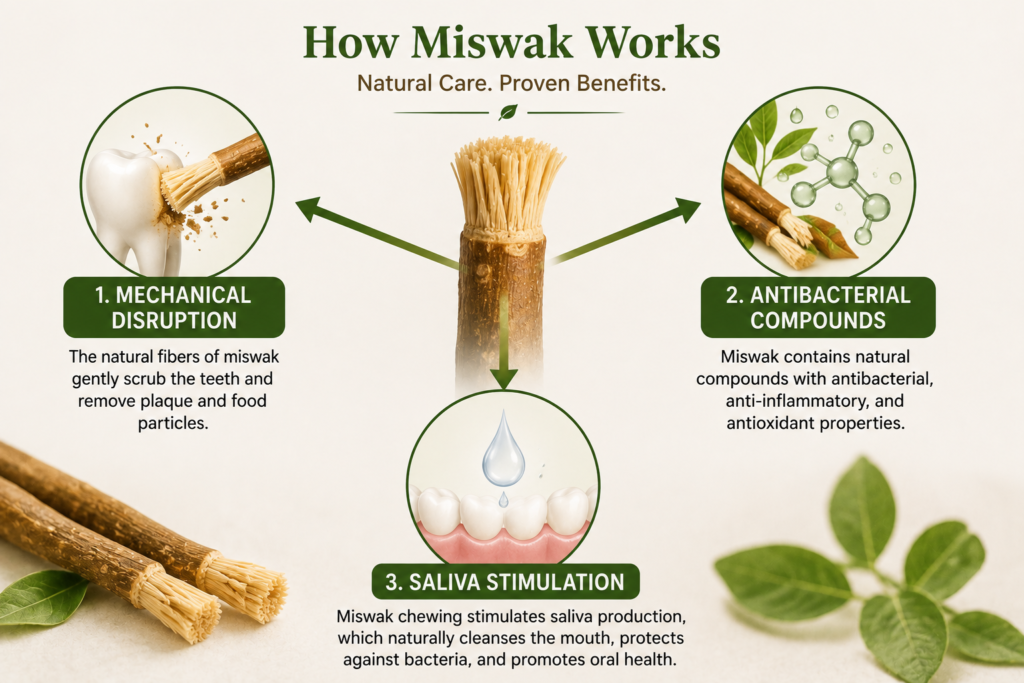
Three mechanisms, running at the same time from one twig.
1. It breaks the biofilm apart mechanically.
When you chew the tip of a fresh miswak, the wood splits into fine fibres that behave like soft bristles. Those fibres sweep across the tooth surface and tear the matrix holding the colony together. The wood also carries natural silica, a mild abrasive that lifts the film and the surface staining that comes with it.
What matters here is that silica sits low on the abrasion scale. You get the disruption without the enamel wear that comes from aggressive whitening pastes. More on that in does miswak whiten teeth.
2. Its compounds slow the regrowth
This is the part a toothbrush cannot replicate. Salvadora persica wood releases a set of active compounds as you use it:
- Benzyl isothiocyanate. The most studied of them. Antibacterial, and repeatedly shown in laboratory work to suppress Streptococcus mutans, the organism most closely tied to tooth decay.
- Tannins. Astringent. They reduce gum inflammation and appear to interfere with the enzymes bacteria use to build the sticky matrix.
- Sulphur compounds and trimethylamine. Antibacterial, and they keep acting for a while after you finish.
- Chlorides. Associated with slower calculus formation, which is the stage you most want to avoid.
- Alkaloids. Mild antibacterial action, and part of the reason fresh arak has that peppery bite.
The practical effect is that the gap between cleanings is not neutral time. Recolonisation is slowed while you go about your day. For the evidence behind these claims, see does miswak actually work and the broader miswak benefits overview.
3. It gets your saliva moving
The overlooked one. Chewing the tip stimulates saliva flow, and saliva is your mouth’s own defence system. It buffers the acid plaque bacteria produce, washes debris away, and carries the calcium and phosphate that repair early enamel damage before it becomes a cavity.
Dry mouth is a well established cavity risk factor. A miswak addresses it directly as a side effect of how you use it. No toothbrush does that.
Why Tartar Is the Real Problem
Plaque left to mineralise becomes calculus, and calculus is not just hardened plaque sitting there inertly. Its surface is rough and porous, which makes it an ideal foundation for fresh plaque to attach to. One neglected patch becomes a permanent plaque factory.
It also creeps below the gumline, where no brush or twig reaches, and that is where gum disease starts in earnest. Bleeding gums, receding gums, and eventually bone loss around the teeth.
Worth being clear about: miswak prevents plaque from reaching this stage. It does not remove tartar once it has formed. Nothing you use at home does. If you already have visible hard deposits, especially behind the lower front teeth, book a scaling appointment first and use miswak to stop it coming back.
What the Research Actually Shows
The evidence is stronger than most traditional remedies manage, but it deserves an honest reading.
Clinical comparisons of miswak users against manual toothbrush users tend to show comparable plaque scores, and several trials have found miswak performing better on gingival health measures. The World Health Organization has formally acknowledged chewing sticks as an effective oral hygiene tool in the regions where they are traditionally used.
The caveat is one that rarely gets mentioned by people selling miswak: a meaningful part of that advantage comes from how often it is used, not purely from the tool. Habitual users clean four or five times a day. Brush users manage two. Compare the two tools at equal frequency and the gap narrows considerably. That does not make miswak worse. It just means the real mechanism is frequency plus chemistry, not magic wood. The tool comparison is in miswak vs toothbrush, and there is a review of the laboratory findings in scientific studies on miswak.
What Miswak Cannot Do About Plaque
Three honest limits. Anyone who skips these is not giving you the full picture.
- It does not clean between your teeth. Roughly 40 percent of a tooth surface sits in the contact points, and miswak fibres are too thick to get in. A toothbrush cannot either. Floss or an interdental brush daily, no exceptions.
- It does not reach below the gumline. Subgingival plaque needs professional cleaning. If your gums bleed regularly, that is a signal to see a dentist rather than to brush harder.
- It does not deliver fluoride. Arak wood contains trace fluoride, nowhere near the 1,000 to 1,450 parts per million in commercial paste. Fluoride hardens enamel against the acid plaque produces, so keep one paste session daily. Detail in miswak vs toothpaste.
Getting the Most Plaque Control From a Miswak
Five things separate people who get real results from people who do not.
- Use a fresh stick. A dried, hardened miswak will not form soft fibres, releases far less of its active compounds, and behaves like sandpaper on enamel. Freshness affects plaque control more than species does.
- Clean often rather than hard. Frequent light sessions keep the film in stage one or two permanently. Heavy scrubbing just causes gum recession. Technique is covered in how to use a miswak stick correctly.
- Give it a full two minutes. Most beginners finish in under a minute, which is not long enough for the compounds to do much.
- Include the gumline. Plaque accumulates first where tooth meets gum. Angle the fibres gently into that junction rather than only across the flat surfaces. If your gums are tender, see miswak for sensitive gums.
- Trim and replace on schedule. Worn fibres go flat and stop disrupting the biofilm. Trim every one to two days, replace the stick every two to four weeks. See signs your miswak needs replacing and how long does miswak last.
Storage matters more than people expect, because a damp sealed miswak grows the very bacteria you are trying to remove. Guidance in how to store miswak properly and hygiene tips for safe miswak use.
Frequently Asked Questions
Does miswak remove plaque as well as a toothbrush?
On the flat surfaces of teeth, yes, studies generally find them comparable, with miswak sometimes ahead on gum health. On the back molars a toothbrush has the easier job because of its angled head. Between the teeth, neither works, and that is what floss is for.
How long does it take to see less plaque?
Most people notice their teeth feeling smoother within a week or two of consistent use, and reduced gum bleeding in a similar window. Existing tartar will not change, because that requires a scaling.
Can miswak remove tartar?
No. Once plaque mineralises it bonds to the enamel and only a dental scaler removes it. Miswak prevents new tartar from forming, which is the far more useful job.
Does miswak work without toothpaste for plaque?
Yes. The fibres provide the mechanical action and the wood provides the antibacterial compounds, so it functions as a complete cleaning tool on its own. You still want fluoride paste once a day, but that is for enamel protection rather than plaque removal.
Which miswak is best for plaque control?
Freshness beats species every time. A mid-grade arak stick sealed last month will outperform a premium one that has been drying on a shelf since spring. Arak is the researched default. Details in types of miswak and best miswak sticks for healthy teeth.
Can using miswak too hard cause problems?
Yes, and it is the most common mistake. Heavy pressure and side to side sawing cause gum recession over time, which exposes root surfaces that collect plaque more readily than enamel does. So over-scrubbing eventually makes your plaque problem worse. Full list in miswak stick side effects.
The Bottom Line
Miswak is effective against plaque because it attacks the biofilm from three directions at once: it breaks it apart, it slows the regrowth chemically, and it boosts the saliva that neutralises the acid. Very few oral care tools do more than one of those.
Use a fresh stick, use it often, use it gently, and keep your daily floss and one fluoride session. Do that and plaque never gets past the stage where it can do any damage.
Buying in volume? Al Safaa Miswak supplies fresh, vacuum-sealed arak sticks to distributors, retailers and oral care brands worldwide, direct from source. Browse our products, see our miswak packaging solutions, or contact us for wholesale pricing.