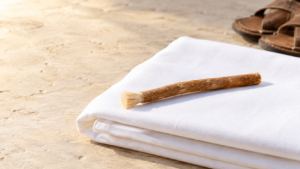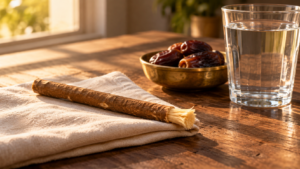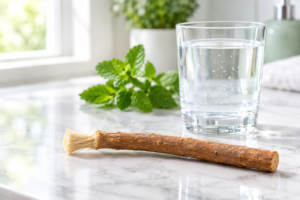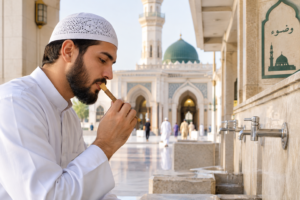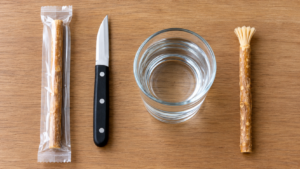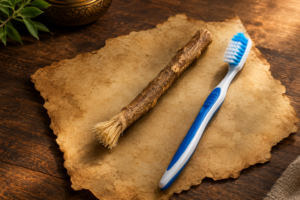
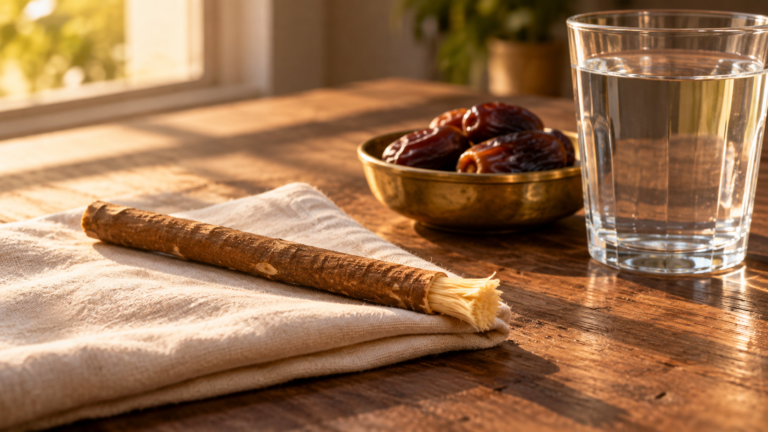
Quick answer: Yes. Using miswak while fasting does not break your fast, and the four major schools agree on that. The only real difference among scholars is timing — the Shafi’i school (and one Hanbali view) considers it disliked after Zuhr, while Hanafis and Malikis permit it all day, wet or dry.
Every Ramadan, the same question circles back. Someone reaches for their miswak around Asr, hesitates, and puts it down again. Was that the right call?
The confusion is understandable, because the answer people hear depends entirely on who they ask. A Hanafi uncle will tell you to use it freely. A Shafi’i imam might tell you to wait until after Maghrib. Both are giving you a real position from within the tradition — they’re just weighing two different pieces of evidence.
This guide lays out what each school actually holds, what the hadith evidence says, what genuinely would invalidate your fast, and how to build a miswak routine that fits around suhoor, the five prayers, Taraweeh, and iftar. If you’re new to the stick itself, our introduction to what miswak is covers the basics first.
Does miswak break the fast?
No. Nothing about placing a miswak in your mouth and cleaning your teeth invalidates a fast.
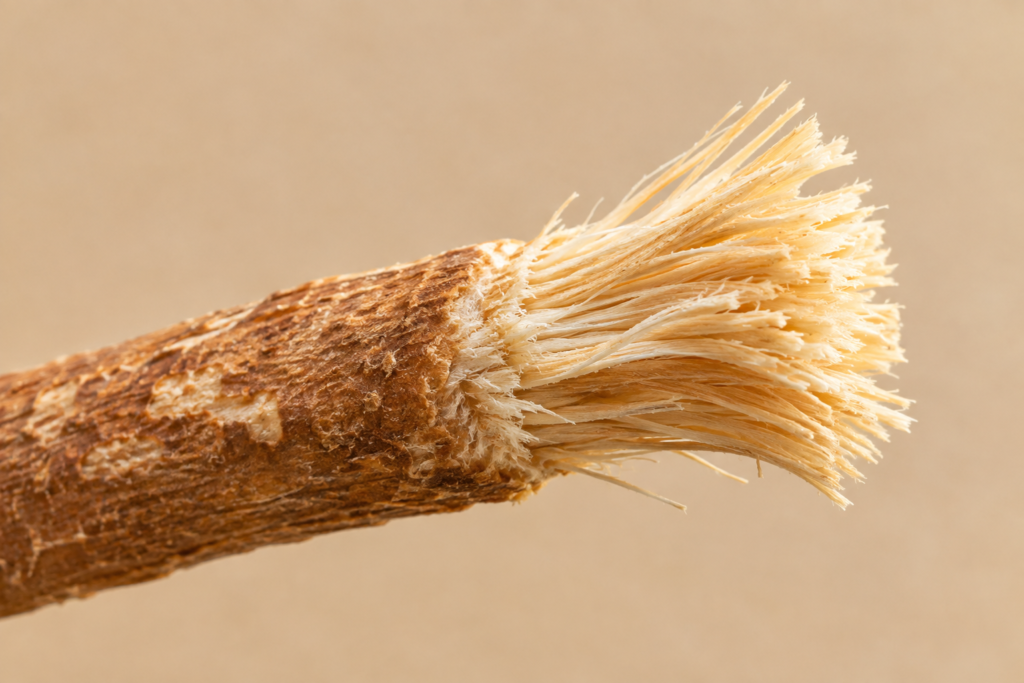
A fast breaks when food, drink, or a similar substance deliberately reaches the throat and passes into the stomach. A miswak does none of that. It’s dry plant fiber; it stays in the mouth, and your own saliva — which you swallow all day anyway, fasting or not — was never a problem to begin with.
The evidence is direct. ‘Amir ibn Rabi’ah reported that he saw the Prophet ﷺ using the siwak while fasting more times than he could count (Tirmidhi, Abu Dawud). Imam al-Bukhari titled an entire chapter in his book of fasting “The fasting person using siwak, moist or dry,” and mentioned that Ibn ‘Umar would use it at the beginning of the day and at the end of it.
That last detail matters, because “the end of the day” is precisely the window people are unsure about.
What each madhhab says about timing
Here’s where the schools part ways, and it’s worth seeing the reasoning rather than just the verdict.
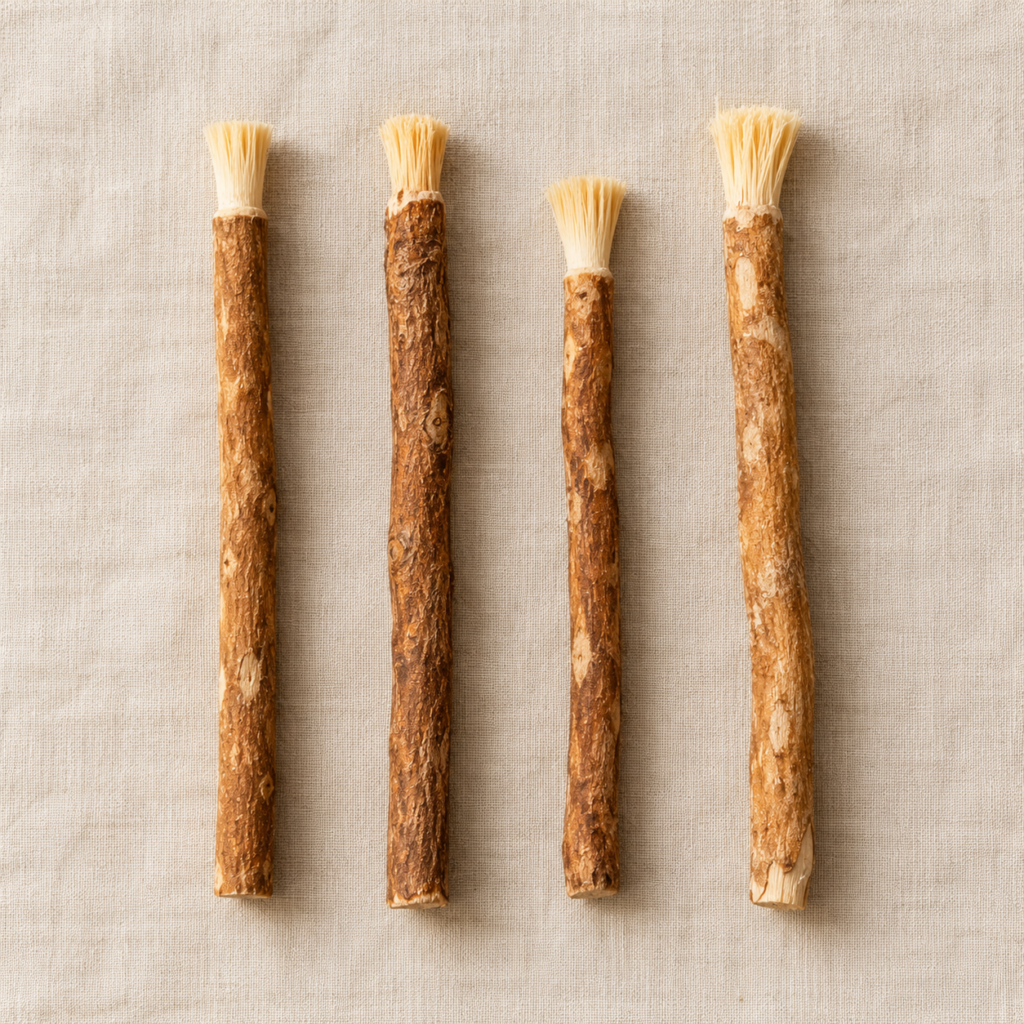
Hanafi. Miswak remains sunnah throughout the fasting day. There is no dislike attached to any hour, and no distinction between a wet stick and a dry one. The general command to use siwak was never restricted to certain times, so Hanafis don’t introduce a restriction the texts didn’t make.
Maliki. Broadly the same permission across the whole day. Malikis add a practical condition: avoid anything that carries a strong taste or might send moisture down the throat. The concern is swallowing, not the stick.
Shafi’i. Permitted before Zuhr, disliked (makruh tanzihi — discouraged, not sinful) from midday until sunset. This is a preference, not a prohibition. If a Shafi’i uses miswak at Asr, the fast is completely valid.
Hanbali. The well-known position mirrors the Shafi’i one regarding a moist stick after midday. Ibn Taymiyyah, and later Shaykh Ibn ‘Uthaymeen, held that it is permitted throughout the day with no dislike at all, which is the view many contemporary scholars follow.
If you already follow a school, follow it. If you don’t, either position is defensible and you’re not doing anything wrong by choosing one.
Why some scholars discourage it after midday
The whole discussion rests on one hadith: that the breath of the fasting person is more beloved to Allah than the scent of musk.
Some jurists read that as a reason to preserve the change in breath that develops through the afternoon, since it is described as praiseworthy. Remove it with a miswak, and you’ve removed something Allah praised.
Scholars who disagree answer on two grounds. First, the hadith praises a state — it doesn’t forbid an action. Second, that smell rises from an empty stomach, not from plaque on the teeth, so a miswak doesn’t actually erase it. You can clean your teeth thoroughly, and the fasting breath still develops.
Neither side is careless with the text. They’re weighing a general encouragement against a specific praise, and landing in different places. Understanding the argument is more useful than memorising a verdict — it tells you why your community may do it differently from the one down the road.
What actually could invalidate your fast
The stick isn’t the risk. Three specific mistakes are, and all of them are easy to avoid.
Swallowing a broken fiber. If a piece of wood snaps off and you deliberately swallow it, that breaks the fast. Swallowing it by genuine accident does not, according to the majority. Trim frayed bristles before Ramadan starts, and this never comes up. Our guide to spotting a miswak that needs replacing covers what a splintering stick looks like.
Soaking the stick and swallowing the water. Dipping a miswak in water is fine. Letting that water run down your throat is the problem. Shake the stick off before it goes near your mouth.
Flavored or treated sticks. Some commercial miswak is soaked in mint, lemon, or other flavoring. Once there’s added taste, you’re no longer dealing with plain plant fibre, and scholars treat it more cautiously. Plain, untreated Salvadora persica avoids the question entirely — which is one more reason to know what tree your miswak comes from.
Notice that all three are about technique and product quality, not about the permissibility of miswak itself.
Wet or dry miswak while fasting?
Dry is the safer default, and for most of the day it’s also the more practical one.
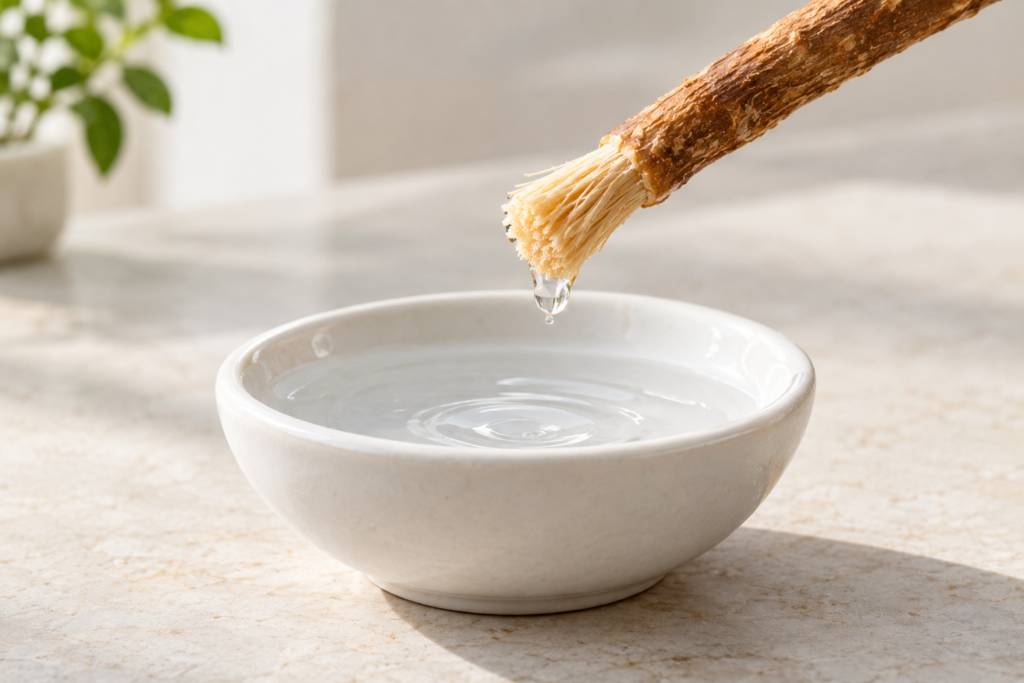
Bukhari’s chapter heading explicitly covers both moist and dry sticks for the fasting person, so a lightly moistened miswak isn’t forbidden. But a dripping stick raises the swallowing question that the schools were nervous about, and it’s an easy thing to sidestep.
A workable approach through Ramadan: keep the stick properly stored so it stays supple on its own and doesn’t need soaking during the day, then rehydrate it fully after iftar. A well-kept miswak doesn’t turn into a wire brush in the first place, which is the whole point of keeping your miswak stored the right way.
A Ramadan miswak routine that works
Ramadan gives you more prayer occasions than any other month, which means more natural moments to use the stick.
After suhoor. Clean thoroughly here. This is your last unrestricted opportunity, and it sets up the whole day — plaque removed at 4am is plaque that isn’t feeding bacteria by 4pm.
Before Fajr, Zuhr, Asr, Maghrib and Isha. A quick pass before wudu, thirty seconds, no water needed.
Before Taraweeh. Long night prayers with a stale mouth are miserable. This one makes a real difference to how the standing feels.
After iftar. Dates, fried food, and sugary drinks all leave residue. Use the miswak once you’ve eaten, and keep your fluoride toothpaste in the routine at night — miswak partners with it rather than replacing it, which we unpack in our comparison of miswak and mouthwash.
Before sleep. Especially if you’re heading straight to bed after Taraweeh.
Miswak for fasting breath and dry mouth
This is the practical reason most people reach for it in Ramadan, separate from the reward.
Fasting slows saliva production, and low saliva is what makes your mouth feel tacky and taste stale by mid-afternoon. Chewing the fibres of a miswak stimulates saliva flow directly, which relieves the dryness without a drop of water passing your lips. The natural antibacterial compounds in Salvadora persica work on the bacteria that produce odour compounds in the first place.
Go gently, though. Long fasting days plus a heavy hand is exactly the combination that leads to sore, receding gums by the third week — the risks and precautions around miswak use apply just as much in Ramadan, and arguably more, since you’re using the stick more often than usual.
Mistakes people make during Ramadan
- Scrubbing harder than usual because the mouth feels dry. Pressure doesn’t fix dryness; saliva does.
- Using the same stick for all thirty days. Four weeks is roughly the outer limit for any miswak.
- Storing it in a hot bathroom through a Ramadan summer, then wondering why it smells musty by week two.
- Stockpiling a month’s worth of sticks with no plan to keep them fresh. If you’re buying a bundle for the month, proper day-to-day technique and handling is what makes stick number twenty as good as stick number one.
- Assuming a ruling from one school applies to everyone, and correcting people in the masjid over it.
Frequently asked questions
Does using a miswak break the fast?
No. It does not invalidate the fast according to any of the four schools. The fast is only broken if something is deliberately swallowed and reaches the stomach, which a miswak does not do.
Can I use miswak after Asr while fasting?
Hanafis and Malikis permit it with no dislike. The Shafi’i school and one Hanbali position consider it disliked after midday, though still permissible. Your fast remains valid either way.
What if a piece of the miswak breaks off in my mouth?
Spit it out. If you swallow it deliberately, the fast is broken. If it goes down by genuine accident, the majority hold that the fast is still valid. Trimming a frayed stick before Ramadan prevents this.
Can I wet my miswak while fasting?
Yes, provided no water is swallowed. Shake off the excess first. A dry stick is the simpler choice during daylight hours.
Is flavoured miswak allowed during fasting?
Plain, untreated sticks are safest. Anything soaked in mint or lemon adds a taste that scholars treat more cautiously, since taste raises the question of something being ingested.
Can I brush with toothpaste while fasting?
Scholars generally permit it if nothing is swallowed, but many discourage it because the risk is real and the need isn’t. Miswak avoids the issue completely, which is why it’s the preferred tool during the day.
Does miswak count as breaking wudu?
No. Using miswak has no effect on wudu. It is recommended before performing it.
The short version
Use your miswak in Ramadan. Every school permits it, the Prophet ﷺ used it while fasting, and it solves the dry mouth and stale breath that make fasting days uncomfortable. If you follow a school that discourages it after Zuhr, front-load your use — suhoor, Fajr, Zuhr—and pick it back up after Maghrib if you don’t, use it freely and just don’t swallow anything.
For rulings tied to your own circumstances, ask a qualified scholar in your community. On the practical side, the quality of the stick decides the rest of it.