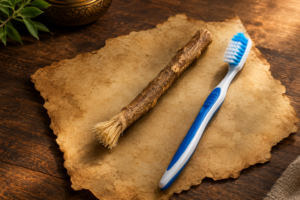
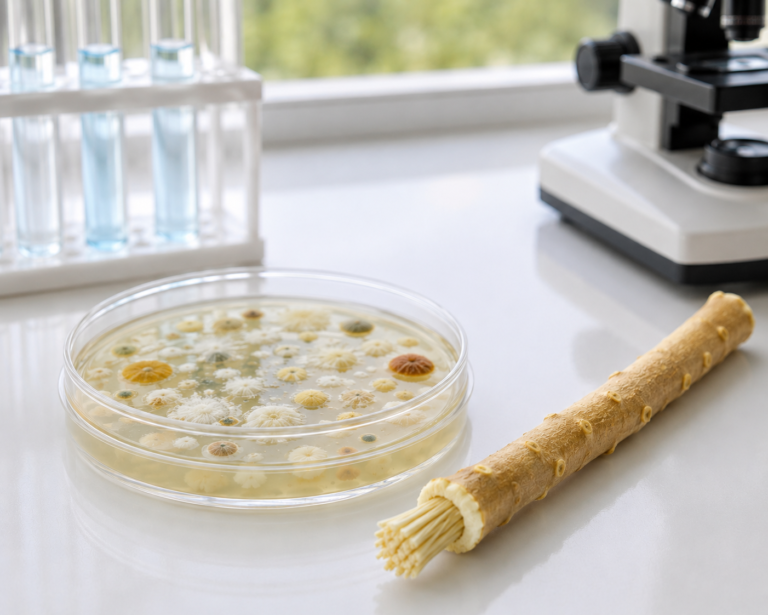
There are somewhere around 700 bacterial species living in the average human mouth, and the overwhelming majority of them are doing you no harm at all. Some are actively useful. A small handful are the reason people lose teeth.
That distinction is where miswak gets genuinely interesting, and it is the part that almost never makes it into the marketing. The wood does not simply kill bacteria. Laboratory work suggests it is unusually selective about which ones it goes after, and the species it hits hardest happen to be the ones you most want gone.
Here is the microbiology, in plain terms.
The Short Answer
Miswak fights oral bacteria by rupturing their outer cell envelope, breaking down the protective matrix they hide inside, shifting the pH of the mouth against them, and sweeping them off the tooth surface mechanically. Four separate attacks, one twig.
What makes it different from a chemical rinse is the targeting. Alcohol-based mouthwash is indiscriminate. Miswak’s main antibacterial compound appears to hit the harmful species considerably harder than the harmless ones, which is a meaningfully better outcome for your mouth over the long run. For the broader evidence picture, see our pillar guide on does miswak actually work.
Which Oral Bacteria Are Actually the Problem
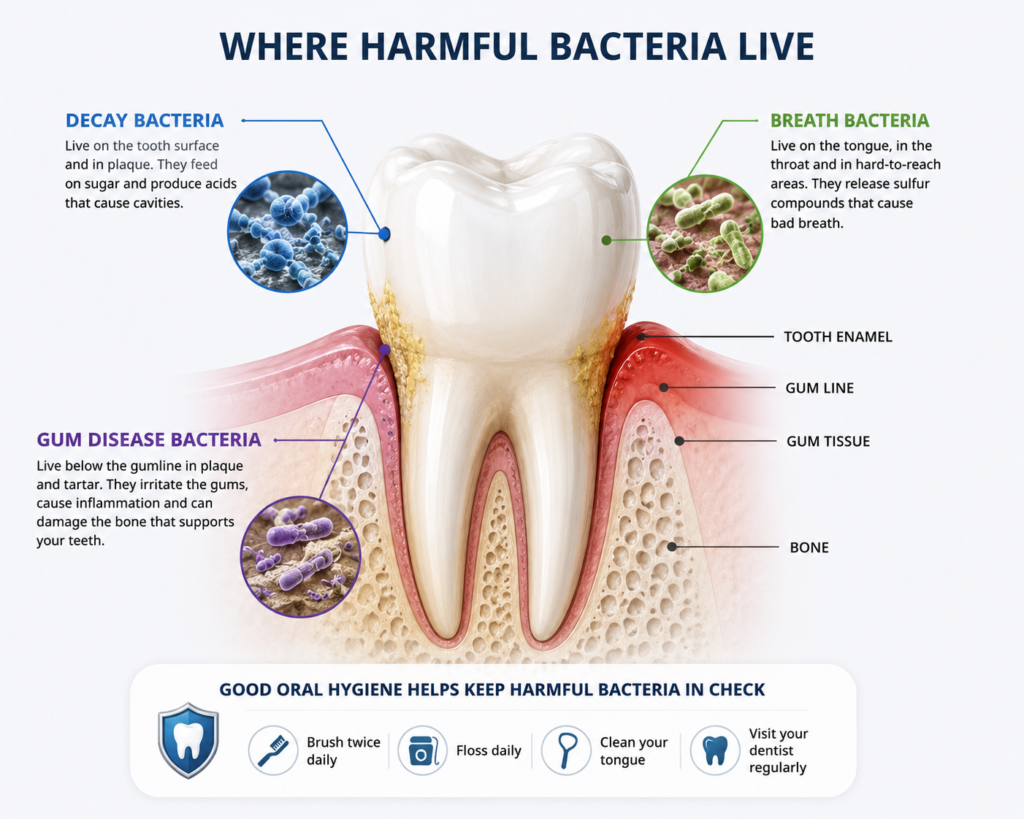
You cannot judge an antibacterial tool without knowing what it is supposed to be fighting. These are the species that matter clinically.
| Bacteria | Type | What it does | Where it lives |
|---|---|---|---|
| Streptococcus mutans | Gram-positive | The main driver of tooth decay. Converts sugar into acid that dissolves enamel | On tooth surfaces, inside plaque |
| Lactobacillus species | Gram-positive | Deepens existing cavities once decay has started | Inside cavities and pits |
| Porphyromonas gingivalis | Gram-negative | A leading agent in gum disease and bone loss around the teeth | Below the gumline |
| Aggregatibacter actinomycetemcomitans | Gram-negative | Linked to aggressive periodontitis, often in younger patients | Deep gum pockets |
| Fusobacterium nucleatum | Gram-negative | Acts as a bridge, letting more harmful species attach to the plaque colony | Middle layers of plaque |
| Prevotella and related species | Gram-negative | Produce the volatile sulphur compounds behind persistent bad breath | Tongue surface, gum pockets |
| Candida albicans | Fungus, not bacteria | Causes oral thrush, particularly under dentures | Soft tissue, denture surfaces |
Notice the pattern in that third column. Most of the gum disease organisms are gram-negative, meaning they have an extra outer membrane wrapped around the cell. That membrane is normally a defensive advantage. Against miswak, it turns out to be a weakness.
Four Ways Miswak Attacks Them
1. It ruptures the bacterial cell envelope
The compound doing most of the work here is benzyl isothiocyanate, usually shortened to BITC. When researchers isolated it from Salvadora persica root and tested it against a panel of oral bacteria, it killed gram-negative species rapidly, and electron microscopy showed visible damage to the bacterial cell envelope afterwards. Not a slowed growth curve. Physical destruction of the cell wall, photographed.
Because the gram-negative group includes most of the serious periodontal pathogens, that is a useful thing for a twig to be good at.
2. It breaks down the shelter they build
Bacteria in the mouth do not float around individually. They build a sticky protective matrix and live inside it, which is what makes them so much harder to kill than bacteria in a test tube. Antiseptics that work fine in a lab often barely dent an established colony.
Tannins in miswak appear to interfere with the enzymes bacteria use to construct that matrix, and saponins add a light detergent action that helps loosen what is already there. Take away the shelter and everything else works better. The structural side of this is covered in how miswak helps prevent plaque build-up.
3. It changes the environment they need
Decay bacteria need an acidic mouth to function. They produce acid from sugar, the acid dissolves enamel, and the low pH also happens to suit them better than it suits their competitors. Acid is both their weapon and their preferred habitat.
Chewing a miswak stimulates saliva flow, and saliva is alkaline. It buffers the acid, raises the pH back toward neutral, and carries calcium and phosphate that repair early enamel damage. Some research indicates miswak use raises the pH of dental plaque specifically, which makes the plaque a less comfortable place for decay-causing species to live.
This mechanism gets overlooked because it is indirect. It does not kill anything. It just makes the mouth a worse place to be a harmful bacterium.
4. It physically removes them
The least glamorous mechanism and arguably the most important. No antibacterial compound reaches bacteria buried under layers of established plaque. The frayed fibres and the natural silica in the wood strip that layer off, which exposes what is underneath to everything else the miswak is doing.
Chemistry without mechanical removal is what mouthwash is, and mouthwash alone has never solved anyone’s bacterial problem. We put the two approaches side by side in miswak vs mouthwash.
Does Miswak Kill the Good Bacteria Too?
This is the question worth asking about any antibacterial product, and miswak comes out of it better than most. Your mouth is not supposed to be sterile. A healthy oral microbiome is a balanced community, and many of the resident species actively compete with the harmful ones for space and nutrients. Wipe everything out and you often get a worse population growing back.
The laboratory finding on BITC is that it acted rapidly on gram-negative bacteria while leaving gram-positive species largely alone. Since a large share of the harmless resident population in the mouth is gram-positive, that selectivity works in your favour.
An honest wrinkle worth knowing: Streptococcus mutans, the main decay organism, is itself gram-positive. So BITC is probably not what miswak is doing to fight cavities. That effect more likely comes from the mechanical scrubbing, the pH shift, the tannins and the trace fluoride working together. Anyone claiming one compound explains every benefit is oversimplifying.
Compare that to an alcohol-based rinse, which strips the mouth broadly and can leave tissue dry. Reduced saliva means reduced natural defence, which is why some people find heavy mouthwash use makes breath problems worse over time rather than better.
Why Selectivity Beats “Kills 99.9% of Germs”
That claim on a bottle sounds like a benefit. In the mouth it is closer to a warning label.
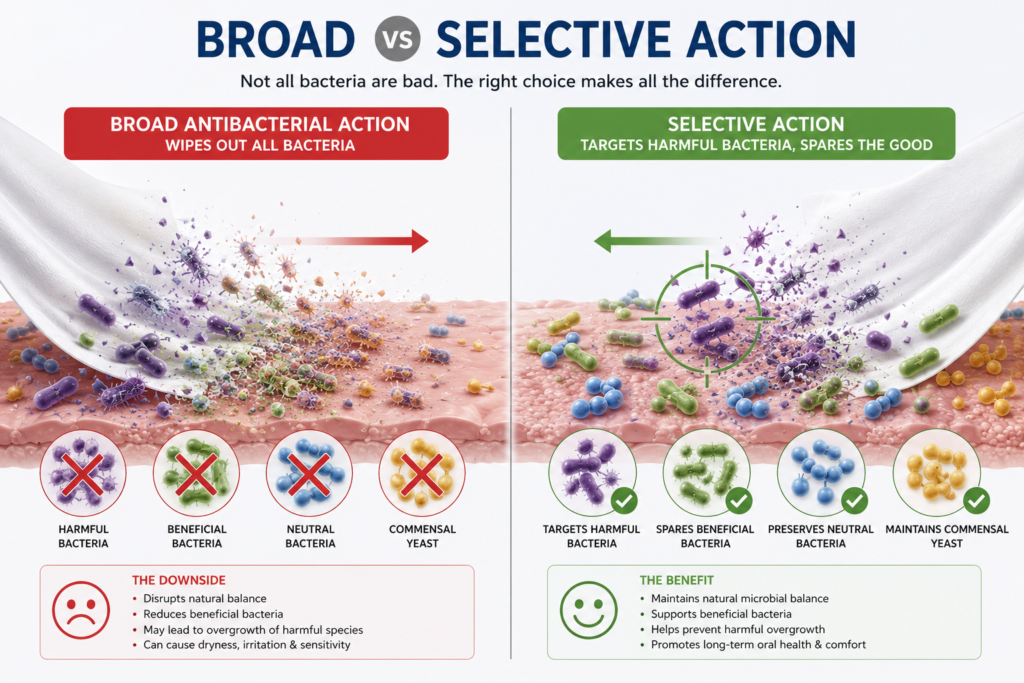
- Balance outperforms sterilisation. Beneficial species occupy space and consume nutrients that harmful ones would otherwise use. Clearing the field just opens it up.
- Saliva stays intact. Miswak increases saliva flow rather than drying tissue, so your mouth’s own antibacterial system keeps running between sessions.
- Multiple mechanisms are harder to adapt to. Bacteria develop resistance most readily against single-target agents. A tool attacking through four different routes at once presents a much harder problem, though this is a reasonable inference from how plant antimicrobials behave rather than something proven for miswak specifically.
- The effect is continuous. Compounds keep working in saliva after you finish, so recolonisation is slowed rather than simply reset.
What Miswak Cannot Do to Oral Bacteria
Four limits. Skipping them would be dishonest, and they matter practically.
- It does not reach below the gumline. The most damaging periodontal bacteria live in deep gum pockets where no twig or brush reaches. That requires professional cleaning. Regularly bleeding gums is a signal to book an appointment, not to press harder.
- It does not treat an existing infection. A dental abscess is a medical problem needing a dentist and usually antibiotics. Miswak is prevention, not treatment.
- It does not clean between the teeth. Around 40 percent of a tooth surface sits in the contact points, which is exactly where several of these species thrive. Floss daily. A toothbrush cannot manage this either.
- It does not sterilise your mouth, and should not. The aim is a balanced population, not an empty one.
How to Actually Get the Antibacterial Effect
The compounds described above only exist in usable quantity under certain conditions. Most people who report no benefit failed on one of these.
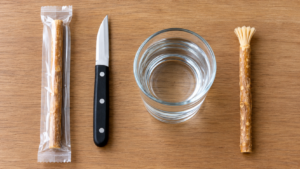
- Use a fresh stick. The volatile antibacterial compounds fade as the wood dries. A stick that has sat on a shelf for months is mechanically fine and chemically close to inert. Storage conditions change the chemistry, as explained in how humidity affects miswak quality.
- Trim the tip daily. The active compounds sit in fresh wood. A tip used for several days is spent. Cutting back to a clean layer is what reactivates the stick, and it takes ten seconds.
- Use it consistently. The antibacterial effect is cumulative rather than instant. Trials measuring bacterial load ran across weeks, not days. Frequency guidance is in how often to use miswak.
- Include the tongue, gently. The species producing bad breath compounds live mostly on the tongue surface, not the teeth. Cleaning teeth alone misses them entirely.
- Buy genuine Salvadora persica. The laboratory results apply to the species tested. A random twig sold as miswak has a different chemical profile. See types of miswak and what tree miswak comes from.
Technique matters too, mostly for avoiding harm rather than boosting the chemistry. Short vertical strokes and light pressure, covered in how to use a miswak stick correctly. If your gums are already tender, start gently and read miswak for sensitive gums.
Frequently Asked Questions
Is miswak actually antibacterial, or is that marketing?
It is measurable. Laboratory studies have tested extracts and the volatile compounds from fresh root against common oral pathogens and found real antibacterial activity, and a 2025 systematic review pooling ten studies across more than 440 participants reported a meaningful reduction in decay-causing bacteria among miswak users. The full evidence review is in does miswak actually work.
Which bacteria does miswak work best against?
Gram-negative species, based on the isolated compound testing. That group includes most of the organisms tied to gum disease, which is consistent with trials showing miswak users doing well on gum health measures specifically.
Can miswak cause antibiotic resistance?
There is no evidence suggesting it does, and the multi-mechanism nature of plant antimicrobials makes it less likely than with single-target drugs. That said, this has not been studied over decades in the way pharmaceutical resistance has, so it is a reasonable expectation rather than a settled fact.
Does miswak help with oral thrush?
Laboratory work shows antifungal activity against Candida albicans, but that is a petri dish result rather than a clinical one. Active thrush needs a proper antifungal from a doctor or dentist. Do not self-treat it with a twig.
How long before the bacterial load drops?
Fresher breath is usually noticeable the same day. Measurable changes in bacterial counts and gum health showed up across two to four weeks of consistent daily use in the trials.
Does miswak work better than toothpaste against bacteria?
Differently rather than better. Toothpaste delivers fluoride, which hardens enamel against bacterial acid but does not do much to the bacteria themselves. Miswak attacks the bacteria directly but delivers almost no fluoride. Using both covers both angles, which is also the arrangement the research supports most strongly. See miswak vs toothpaste and miswak vs toothbrush.
The Bottom Line
Miswak fights oral bacteria on four fronts at once: it ruptures cell envelopes, dismantles the matrix bacteria shelter in, shifts the pH against them, and physically strips them off the enamel. Very few oral care products manage more than one of those.
The more interesting point is the targeting. A tool that reduces the harmful population while leaving the useful residents mostly intact is a better long-term proposition than one that clears everything indiscriminately.
None of it happens with a dried-out stick, though. Freshness is not a quality detail here. It is the active ingredient.
Buying in volume? Al Safaa Miswak supplies fresh, vacuum-sealed Salvadora persica sticks to distributors, retailers and oral care brands worldwide, harvested from genuine arak trees and processed to export-grade hygiene standards. Browse our products, see our miswak packaging solutions, or contact us for wholesale pricing.