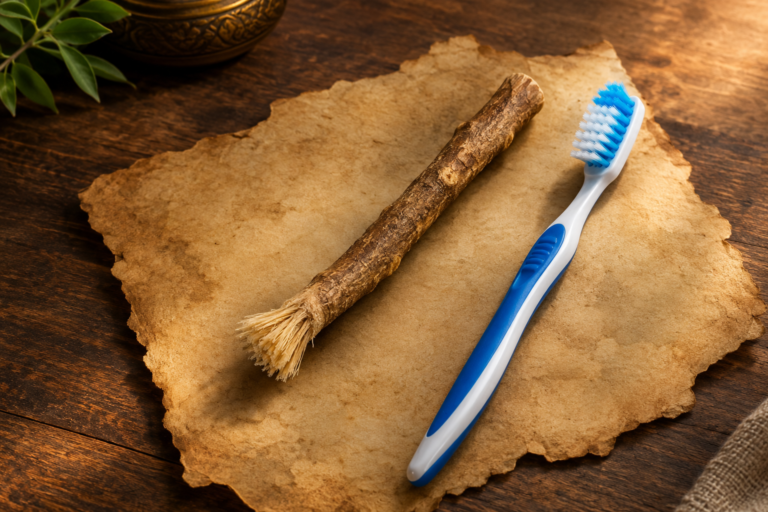
Almost every oral care product in your bathroom was invented in the last hundred and fifty years. Nylon bristles arrived in 1938. Fluoride toothpaste reached shops in the 1950s. Floss as a mass-market product is younger than the aeroplane.
The miswak predates all of it by several thousand years, and it has never really gone away. That is a strange thing for a piece of technology to manage, so this post traces how it happened: where the chewing stick came from, how the arak twig became the version most of the world knows, and why it survived the arrival of the toothbrush when so many traditional remedies did not.
The Short Answer
Chewing sticks are among the oldest oral hygiene tools known, with archaeological traces going back thousands of years across Mesopotamia, Egypt, China, and India. The miswak specifically refers to the version cut from Salvadora persica, the arak tree, which became the dominant form across the Arabian Peninsula and then spread with Islamic civilization into Africa, Central Asia, and South Asia.
It survived the invention of the toothbrush because it was tied to a daily religious practice rather than to fashion and because it happened to work. Background on the tool itself is in what is miswak.
A Note on the Dates You See Quoted
Before the timeline, something worth saying plainly, because almost nobody writing about miswak says it.
You will see the figure “7,000 years” repeated everywhere, usually with no source attached. Other articles say 5,000. Some say 4,000. These numbers get copied from one page to the next until they read as established fact.
What is genuinely well supported is that chewing sticks were in use across several ancient civilizations, that examples have been recovered from burial sites, and that written references to twig cleaning appear in ancient medical texts. What is much shakier is any precise founding date. Wood decays. Twigs are not the sort of artifact that survives well, and the ones that do are hard to date narrowly.
The honest version: chewing sticks are demonstrably ancient, plausibly five to seven thousand years old, and the exact figure is an estimate rather than a measurement. Anyone quoting a precise number with confidence is repeating something they read rather than something anyone established.
The First Chewing Sticks
The earliest widely cited evidence comes from Mesopotamia, where chewing sticks have been associated with Babylonian burial sites. Similar finds have been reported from Egyptian tombs, where twigs were placed alongside the dead in the same way as other personal possessions. That detail says something: these were not disposable objects. They were personal and worth taking with you.
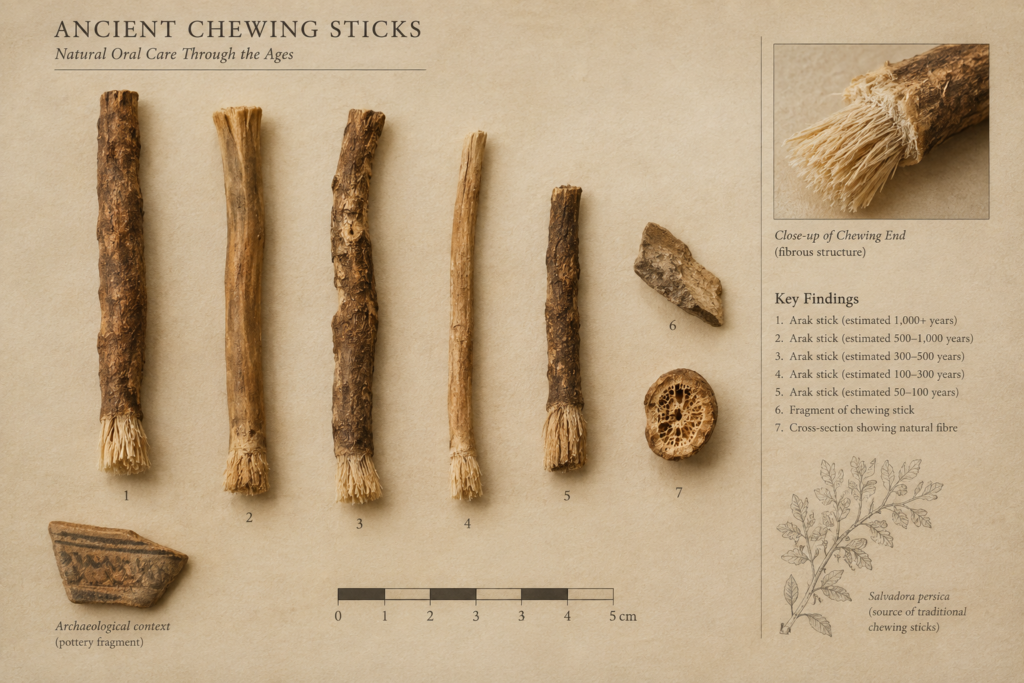
Ancient Egyptian medical writing, including the surviving papyri that catalogue remedies, includes material on dental complaints, which tells us tooth trouble was a recognised problem long before anyone understood bacteria.
The idea appears independently elsewhere. Chinese sources describe aromatic twigs used to clean teeth and freshen breath. In India, twig cleaning is embedded in Ayurvedic practice, with neem and other species used as datun, and the classical Ayurvedic medical compendia include instructions on the practice. Different continents, no contact, same solution.
The Arabian Peninsula and the Arak Tree
Salvadora persica grows in hot, arid, often saline ground where little else thrives. Across the Arabian Peninsula, the Horn of Africa, and parts of South Asia, it was simply the tree that was there.
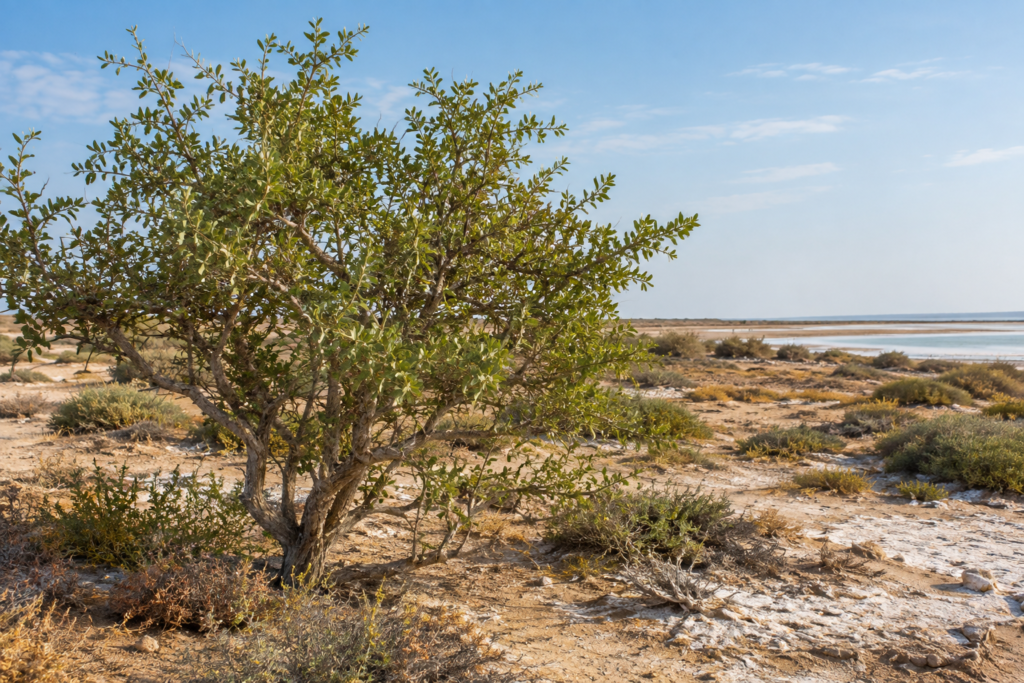
It also turned out to be a particularly good choice, though nobody could have known why at the time. The wood is fibrous enough to split into usable bristles, soft enough not to damage gums, and carries a chemical profile that modern analysis has found to include natural abrasives, antibacterial compounds, and astringents. The botanical detail is in what tree miswak comes from, and the chemistry in how miswak fights oral bacteria.
Arak was in use in the region before the seventh century. What changed after that was not the tool but the habit around it.
The Seventh Century: A Tool Becomes a Routine
This is the pivot point in the whole story.
Islamic teaching attached the siwak to specific moments in the day, particularly before prayer and before ablution. That single change turned an occasional cleaning tool into a habit performed several times daily by an entire civilization, and it carried the practice across continents as that civilization spread. North Africa, Andalusia, Central Asia, the Swahili coast, South Asia, and eventually Southeast Asia.
It also gave the practice something no commercial product has: a reason to persist that had nothing to do with marketing or fashion. We cover the narrations, the recommended occasions, and the etiquette separately, since that is a subject in its own right.
Trade did the rest. Arak sticks moved along the same Indian Ocean and overland routes as textiles and spices, which is why you find the practice established in places where the tree does not grow.
The Physicians of the Islamic Golden Age
Between roughly the ninth and thirteenth centuries, oral care was being written about seriously rather than passed on only by habit.
Al-Zahrawi, known in Latin Europe as Abulcasis, worked in Cordoba in the tenth and early eleventh centuries. His medical encyclopaedia included substantial material on dentistry: he described hardened deposits on the teeth, designed instruments for scraping them away, and wrote about the consequences of neglecting the mouth. That is recognizably the ancestor of a modern scaling appointment, several centuries early.
Ibn Sina, known as Avicenna, addressed oral hygiene and dental complaints in his own medical writing, which remained in use in European universities for centuries afterwards.
The point is not that these physicians invented the miswak. It is that they were treating oral hygiene as a medical subject with its own instruments and literature, in a period when much of Europe was not. The miswak sat inside that framework as everyday practice rather than folk remedy.
The Bristle Toothbrush Arrives
The first recognizable bristle toothbrush is generally credited to China around the end of the fifteenth century, made from coarse animal bristle set into a bamboo or bone handle. The design travelled to Europe, where it stayed an expensive curiosity for a long while.
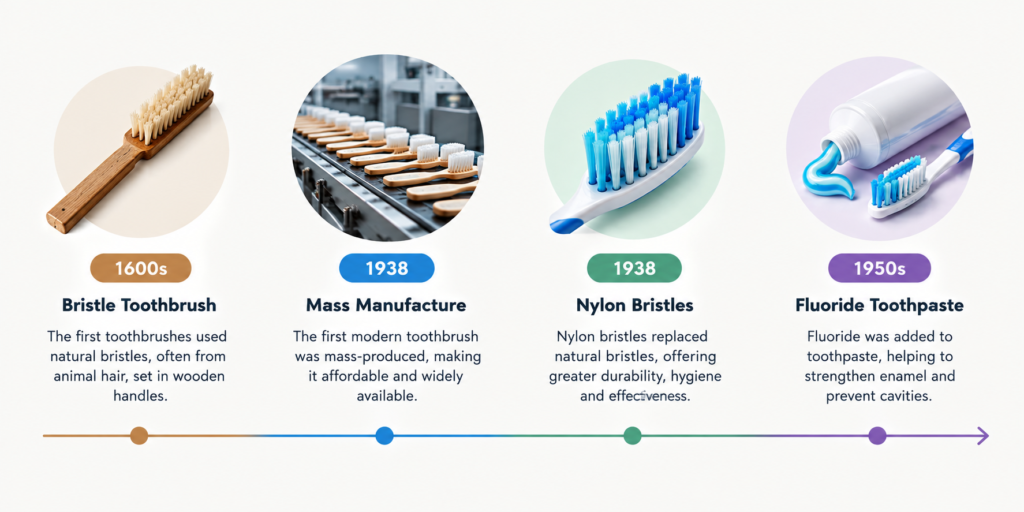
Mass production is usually traced to William Addis in England around 1780. The rest arrived quickly by historical standards:
| Roughly when | What happened? |
|---|---|
| Late 15th century | First bristle toothbrushes recorded in China |
| c. 1780 | Mass manufacture begins in England. |
| Mid-19th century | First toothbrush patents filed in the United States |
| 1938 | DuPont introduces nylon bristles, replacing animal hair. |
| 1950s | Fluoride toothpaste reaches the mass market. |
| 1960s onward | Electric toothbrushes become widely available. |
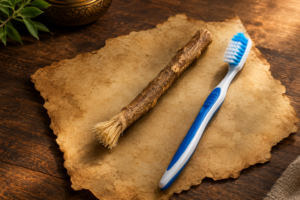
Two things about that list are worth noticing. First, how recent all of it is. Second, that the toothbrush and the miswak are not really the same category of object. One is a delivery mechanism that needs paste to function fully. The other is self-contained. We set the two side by side in miswak vs toothbrush.
The Twentieth Century Squeeze
The miswak lost ground through much of the twentieth century, and the reasons were mostly not dental.
- Colonial and post-colonial administration brought imported dental products and, with them, the assumption that manufactured meant modern and traditional meant backward.
- Urbanization separated people from the trees. A twig you can cut yourself becomes a product you have to source.
- Marketing budgets went to toothpaste. No one advertises a stick.
- Fluoride was a genuine advance. This one is not perception. Fluoride toothpaste demonstrably reduces cavities, and the miswak has no equivalent. It remains the one clear gap, discussed in miswak vs toothpaste.
The practice persisted anyway, mostly because it was tied to daily religious routine rather than to consumer preference. That is the difference between a habit and a product.
The Research Turnaround
From the 1960s onward, researchers started running chewing sticks through proper laboratory and clinical testing, largely expecting to document a quaint tradition. The results were more interesting than that.
Chemical analysis kept identifying active compounds in Salvadora persica. Clinical comparisons kept finding plaque and gum outcomes broadly level with a standard toothbrush. In the 1980s the World Health Organization formally recognized chewing sticks as an effective oral hygiene tool in populations where they were already in use and called for further study.
That recognition mattered commercially as much as scientifically. It moved the miswak out of the folk remedy category and into the evidence-based one. The current state of that evidence is summarized in does miswak actually work, with the whitening-specific research in scientific studies on miswak and teeth whitening.
A Compressed Timeline
| Period | Development |
|---|---|
| Ancient Mesopotamia and Egypt | Chewing sticks in use, examples recovered from burial sites |
| Ancient China and India | Independent traditions of twig cleaning, neem datun in Ayurvedic practice |
| Pre-7th century Arabia | Arak wood established as the preferred chewing stick in the region |
| 7th century onward | The siwak becomes a daily practice tied to prayer, spreading with Islamic civilization. |
| 10th to 13th centuries | Physicians including Al-Zahrawi and Ibn Sina write systematically on oral hygiene and dental instruments. |
| Late 15th century | The bristle toothbrush appears in China. |
| c. 1780 | Mass toothbrush manufacture begins in England. |
| 1938 to 1950s | Nylon bristles, then fluoride toothpaste, reshape oral care. |
| 1960s onward | Laboratory and clinical research on Salvadora persica accumulates. |
| 1980s | WHO recognizes chewing sticks as an effective oral hygiene tool. |
| 2000s to present | Renewed global demand, driven by natural products, sustainability, and research |
Where the Miswak Stands Now
The current position is a reasonable one. It is not being sold as a replacement for modern dentistry, and it is no longer dismissed as tradition either.
Three things are driving current demand. The natural products market, which favors something with a five-ingredient list of nothing but wood. Environmental concern, since a plastic toothbrush head every three months adds up and a twig composts. And the research base, which gives retailers something defensible to point at.
The practical guidance has not changed much across all those centuries: use a fresh stick, use it often, and use it gently. Modern additions are the fluoride session at night and daily flossing. Frequency guidance is in how often to use miswak, technique in how to use a miswak stick correctly, and the plaque mechanism in how miswak helps prevent plaque build-up.
Frequently Asked Questions
How old is the miswak?
Chewing sticks are commonly described as five to seven thousand years old, based on finds associated with ancient Mesopotamian and Egyptian sites. Treat those figures as estimates. Wood does not survive well, so precise dating is difficult, and the numbers in circulation are inherited rather than measured.
Who invented the miswak?
Nobody, in the sense of a single inventor. Chewing sticks appear independently across several ancient civilizations, which is what you would expect from an obvious solution using locally available material. What is specific to the miswak is the choice of Salvadora persica and the daily routine built around it.
Was miswak used before Islam?
Yes. Chewing sticks, including arak, were in use in the region beforehand. What the seventh century added was structure: specific recommended occasions, which turned occasional use into a daily habit and carried it across continents.
Why did the toothbrush replace the miswak in most places?
Distribution and manufacturing rather than performance. Toothbrushes could be produced at scale, exported, and advertised. Fluoride toothpaste was also a real advance the miswak could not match. In regions where the practice was tied to daily religious routine, it persisted regardless.
Is the miswak still used today?
Widely across the Middle East, South Asia, East and West Africa, and Muslim communities worldwide, and increasingly among people who came to it through the natural products and low-waste markets rather than through tradition.
Did other cultures use different woods?
Yes, and many still do. Neem across South Asia, olive through the Levant, and various local species across West Africa. Arak is the variety most of the clinical research is based on. See types of miswak.
The Bottom Line
The miswak is the rare case of a tool that was right the first time. Ancient civilizations reached for chewing sticks independently, the arak version proved unusually well suited to the job, and a daily religious routine kept the practice alive through the centuries when almost every other traditional remedy was displaced.
Then the laboratories caught up and found the tradition had been onto something measurable. Not many folk practices survive that test.
What has not changed in several thousand years is the requirement: the stick has to be fresh. Every culture that used chewing sticks cut them fresh, because a dried twig does not work. That is still the whole game.
Buying in volume? Al Safaa Miswak supplies fresh, vacuum-sealed Salvadora persica sticks to distributors, retailers, and oral care brands worldwide, harvested from genuine arak trees and processed to export-grade hygiene standards. Learn more about us, browse our products, see our miswak packaging solutions, or contact us for wholesale pricing.