People have cleaned their teeth with miswak for over a thousand years — and many notice their teeth looking brighter for it. But tradition and personal experience aren’t the same as scientific proof. So what does the actual research say?
This post walks through the real studies on miswak (Salvadora persica) and teeth whitening — what they tested, what they found, and, just as importantly, where the evidence has gaps. It’s an honest, plain-English look at the science, not a sales pitch.
If you want the practical takeaways first, our main guide on whether miswak whitens teeth covers the everyday side. This post is the evidence behind it.
Quick Summary: What the Evidence Shows
In short:
Laboratory studies support miswak as a genuine stain remover. Research has found natural abrasive crystals in miswak fibre that lift coffee and tea stains, and toothpaste made with Salvadora persica extract has matched or beaten commercial whitening toothpaste at removing and preventing stains in lab tests. Broader reviews agree miswak removes plaque and surface stains about as well as a soft toothbrush. The catch: most whitening-specific studies are small, lab-based (in vitro), and preliminary — so the effect is best described as proven stain removal, not enamel bleaching.
What Are the Studies Actually Testing?
Before the findings, one key point that shapes everything. When scientists study miswak “whitening,” they’re testing its ability to remove and prevent extrinsic (surface) stains — the discolouration coffee, tea, and food leave on the outside of the enamel.
They are not testing whether miswak bleaches the tooth lighter than its natural colour, the way peroxide gels do. This distinction matters, because it’s exactly what the results confirm: miswak cleans stains off, revealing the tooth’s natural brightness. Keep that framing in mind as we go through the studies.
The Key Studies, One by One
1. Miswak’s natural abrasive crystals (Halib et al., 2017)
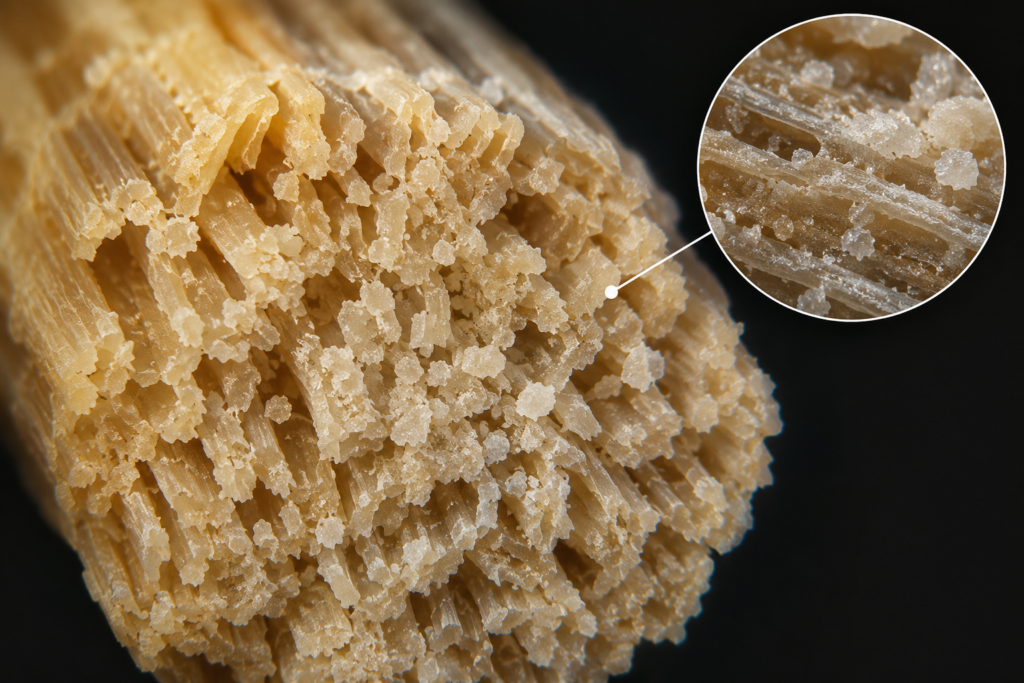
This was the first study to focus specifically on miswak’s whitening behaviour, published in the Journal of Applied Pharmaceutical Science. Researchers ground Salvadora persica into powder and examined it under a scanning electron microscope (SEM), then analysed its makeup with energy-dispersive X-ray spectroscopy (EDX).
What they found is the mechanical heart of miswak whitening: the fibre contains natural mineral crystals of various shapes and sizes that act as gentle abrasives — the same kind of polishing action that lifts surface stains. The mineral analysis showed the powder was rich in oxygen, carbon, sulphur, calcium, sodium, and potassium. In plain terms, the study identified a built-in, natural polishing system inside the stick, and tested it against coffee- and tea-stained teeth.
2. Miswak toothpaste vs commercial whitening toothpaste (removing stain)
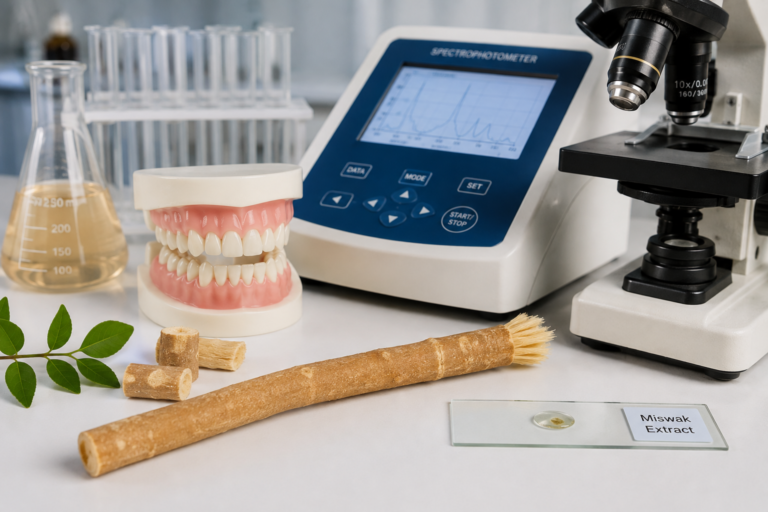
A randomized in vitro study compared three treatments on stained acrylic samples: a toothpaste made with Salvadora persica extract, a commercial whitening toothpaste, and plain water as a control. Samples were repeatedly exposed to tea and chlorhexidine to build up stain, then measured with a spectrophotometer and the Lobene stain index — standard tools for measuring tooth discolouration objectively.
The result was striking: the Salvadora persica toothpaste removed the most stain, ahead of the commercial whitening toothpaste, with water trailing far behind. A natural extract outperforming a manufactured whitening product is a meaningful finding, even in a lab setting.
3. Miswak extract at preventing new stains
A companion in vitro study, published in the Indonesian Journal of Dental Research, looked at the flip side: not just removing stain, but preventing it from forming. Using the same spectrophotometer-and-stain-index approach across sixty samples, researchers found a statistically significant difference between groups (p<0.001), with the Salvadora persica extract more effective at preventing stain formation than the commercial whitening toothpaste. So miswak’s compounds appear to fight staining from both directions — lifting what’s there and resisting what’s coming.
4. The broader reviews: miswak vs the toothbrush
Beyond whitening-specific work, a large body of research — including randomised controlled trials and systematic reviews — has compared miswak with the conventional toothbrush for oral cleaning. The consistent conclusion is that miswak removes plaque and superficial stains comparably to a soft toothbrush. Since surface-stain removal is what makes teeth look brighter, this whole body of evidence indirectly supports miswak’s brightening effect too.
The Studies at a Glance
Here’s the research summarised in one scannable table:
| Study | Type | Year | Key Finding |
|---|---|---|---|
| Halib et al. (extracted stained teeth) | In vitro (lab) | 2017 | Found natural abrasive crystals in miswak fibre that help lift coffee and tea stains |
| Salvadora persica vs commercial whitening toothpaste | In vitro (lab) | Comparison | Miswak-extract toothpaste removed more stain than a commercial whitening toothpaste |
| S. persica on preventing tea & chlorhexidine stain | In vitro (lab) | Comparison | Miswak extract was more effective at preventing new stain forming (p<0.001) |
| Reviews of miswak vs toothbrush | Reviews / RCTs | Various | Miswak removes plaque and surface stains comparably to a soft toothbrush |
Why Miswak Works: What the Science Points To
Pulling the studies together, the whitening effect comes from two scientifically supported mechanisms:
- Mechanical (physical) action. The natural abrasive crystals and fibres identified under the microscope physically polish surface stains off the enamel.
- Chemical action. Miswak’s known compounds — silica, benzyl isothiocyanate, fluoride, and tannins — give it antibacterial and antiplaque properties that reduce the film and staining bacteria that dull teeth. Our post on miswak sticks for teeth goes deeper into these compounds.
Together, that’s a natural tool that both scrubs stains away and helps keep new ones from settling — which is exactly what the lab results show.
Being Honest About the Limitations
A trustworthy look at the science has to include what the studies can’t yet tell us. This is where a lot of online claims overreach.
What the evidence does NOT prove:
Most whitening-specific miswak studies are in vitro (done in a lab on extracted teeth or acrylic samples, not living mouths), small in scale, and described by their own authors as preliminary. There is no large, long-term human trial focused purely on miswak whitening. And crucially, none of it shows miswak bleaches enamel lighter than its natural shade — the proven effect is surface-stain removal.
These limits don’t cancel the positive findings — lab studies are a valid, important first step, and they point clearly in miswak’s favour. They simply mean the honest claim is “a research-supported natural stain remover,” not “a clinically proven bleaching agent.” That distinction is what separates credible information from hype.
What This Means for You
Put simply: the science backs up what miswak users have long noticed. If your teeth have dulled from coffee, tea, or everyday eating, the research supports miswak as a genuine, natural way to lift those surface stains and reveal your teeth’s natural brightness — gently, and without harsh chemicals.
For a deeper picture of realistic results and how to get them, the pillar guide on whether miswak whitens teeth pulls the practical side together.
Frequently Asked Questions
Is there scientific evidence that miswak whitens teeth?
Yes. Laboratory studies have identified natural abrasive crystals in miswak that remove coffee and tea stains, and toothpaste containing Salvadora persica extract has matched or beaten commercial whitening toothpaste at removing and preventing stains. The evidence supports stain removal rather than chemical bleaching.
How do scientists measure miswak’s whitening effect?
Mainly with spectrophotometers, which measure tooth colour objectively, and stain indexes like the Lobene index. Microscopy (SEM) and X-ray analysis (EDX) are used to study the fibre’s abrasive, mineral structure.
Does miswak whiten better than whitening toothpaste?
In at least one in vitro study, a Salvadora persica extract toothpaste removed more stain than a commercial whitening toothpaste. That’s promising, but it’s a lab result — real-world performance depends on the product, freshness, and technique.
Are the miswak whitening studies reliable?
They’re credible and consistent, but mostly in vitro and preliminary. They’re a strong starting point, not the final word. Larger, long-term human trials focused on whitening are still needed.
Does miswak bleach teeth like professional whitening?
No. The research shows miswak removes surface stains to restore your natural shade. It does not bleach enamel lighter than its natural colour — that’s what professional peroxide treatments do.
The Bottom Line
The scientific studies tell a clear, honest story: miswak is a research-supported natural stain remover. Lab work has pinpointed the abrasive crystals and active compounds behind its whitening effect, and comparison studies show it holding its own against — and sometimes beating — commercial whitening products at lifting and preventing stains. The evidence is still early-stage and lab-based, but it points firmly in one direction: miswak genuinely helps brighten teeth by cleaning them, naturally.
And the research only reflects genuine, quality miswak. If you’re a retailer, distributor, or wholesale buyer looking for authentic Salvadora persica miswak — the real thing behind these studies — explore our miswak product range or get in touch with our team.